

In January 2026, a collapsed pipe dumped 244 million gallons of raw sewage into the Potomac River, exposing the fragile, crumbling reality of America’s water infrastructure.
We are watching the slow-motion failure of the systems that keep us alive.
But this isn’t the first time a superpower has watched its water systems fail.
Over 600 years ago, the Khmer Empire of Angkor — the greatest hydraulic city in the pre-industrial world — faced the exact same crisis.
They built massive reservoirs, intricate canals, and complex water management systems that sustained a million people.
But when the climate shifted and the infrastructure crumbled under its own weight, the empire collapsed.
They relied entirely on a centralized system they could no longer maintain.
When the water stopped flowing, the city died.
The lesson is clear: true security comes from systems you control, not systems you depend on.
If you rely on the municipal grid for your family’s water, you are vulnerable to the exact same collapse.
You need a decentralized, off-grid solution.
You need to capture, store, and purify your own water — starting now.
The Frontier Parallel: How American Pioneers Solved This Exact Problem
During the expansion of the American frontier, pioneers didn’t have municipal water lines.
There were no pipes, no treatment plants, no emergency crews to call.
They relied on rainwater catchment, hand-dug cisterns, and gravity-fed systems to survive in harsh, unforgiving environments.
A typical 1880s homestead in the Great Plains would collect rainwater off the roof into wooden barrels, filter it through sand and charcoal, and store it in an underground cistern to stay cool and clean through the summer.
This wasn’t primitive — it was engineered resilience.
They understood something we’ve forgotten: every drop of water that falls on your property is yours to capture.
The Angkor engineers built a city of a million people on this same principle — until they stopped maintaining the system and let it fail.
The frontier homesteader never made that mistake, because they were the system.
There was no one else to call.
The Teachable Strategy: Build Your Own Off-Grid Rainwater Catchment System
This is the one skill that directly addresses the infrastructure vulnerability we’re watching unfold in real time.
It requires no special permits in most states, costs under $300 to get started, and can be built in a single weekend.
Here is exactly what the frontier homesteaders did — and how you replicate it today.
Materials List
| Item | Approximate Cost | Where to Find |
|---|---|---|
| Food-grade IBC tote (275 gal) or rain barrel (55 gal) | $50–$150 | Farm supply stores, Craigslist |
| First-flush diverter kit (or DIY PVC parts) | $20–$50 | Hardware store or online |
| Gutter guards and downspout connectors | $15–$30 | Hardware store |
| Cinder blocks or treated lumber for tank stand | $20–$40 | Hardware store |
| Gravity-fed ceramic filter (Berkey or equivalent) | $50–$150 | Online retailers |
| Unscented household bleach (for treatment) | $5 | Any grocery store |
Step-by-Step Instructions
Step 1: Calculate Your Catchment Potential
Before you buy anything, you need to know how much water you can actually harvest.
The formula is simple: 1 inch of rain on a 1,000 square foot roof yields roughly 600 gallons of water.
Measure the footprint of your roof (length x width).
Check your local average annual rainfall at weather.gov.
Even in relatively dry climates, a standard roof can capture thousands of gallons of water every year.
Step 2: Prepare Your Collection Surface
Your roof is your primary collection surface.
Metal roofs are ideal because they shed water quickly and don’t leach chemicals.
If you have asphalt shingles, you can still collect water, but it must be heavily filtered before consumption.
Clear your gutters of debris, leaves, and dirt before connecting your system.
Install gutter guards to prevent large organic matter from entering your downspouts.
Step 3: Install a First-Flush Diverter
This is the most critical component of a clean, safe water system.
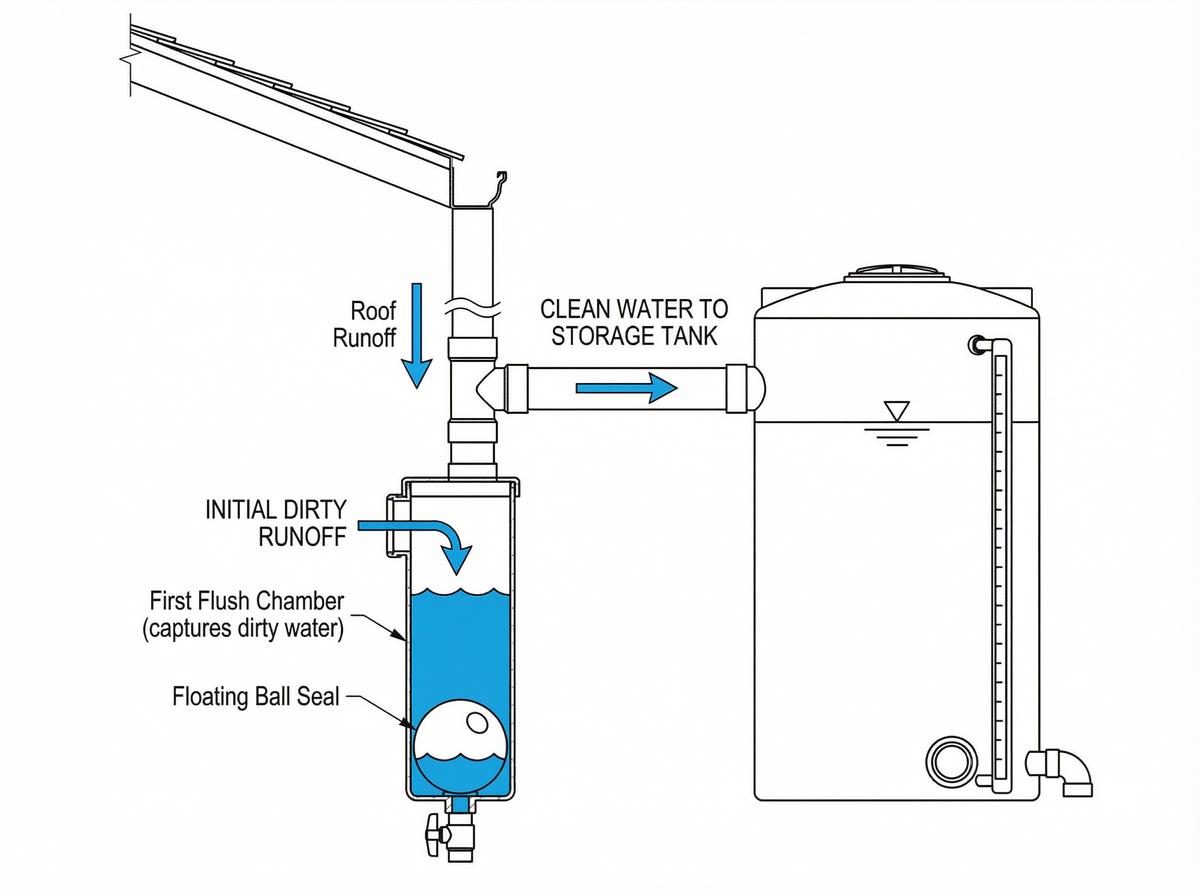
When it first starts raining, the water washes dust, bird droppings, and pollutants off your roof.
A first-flush diverter captures this initial, dirty runoff in a separate pipe.
Once that pipe fills, a floating ball seals it off, allowing the clean, subsequent rain to flow directly into your main storage tank.
You can build a simple diverter using 4-inch PVC pipe, a T-junction, and a screw-on cleanout cap at the bottom — total cost under $20.
Step 4: Set Up Your Storage Tanks
You need food-grade, UV-resistant storage containers.
High-density polyethylene (HDPE) IBC totes (275–330 gallons) or dedicated rain barrels are excellent choices.
Place your tanks on a sturdy, level foundation — elevated on cinder blocks or a reinforced wooden stand to utilize gravity for water pressure.
Water is incredibly heavy — roughly 8.3 pounds per gallon.
A full 275-gallon tote weighs over 2,200 pounds. Build your platform accordingly.
Ensure your tanks are completely opaque or painted to block sunlight, which prevents algae growth inside the tank.
Step 5: Implement a Multi-Stage Filtration System
Harvested rainwater is excellent for irrigation and sanitation, but it must be purified before drinking.
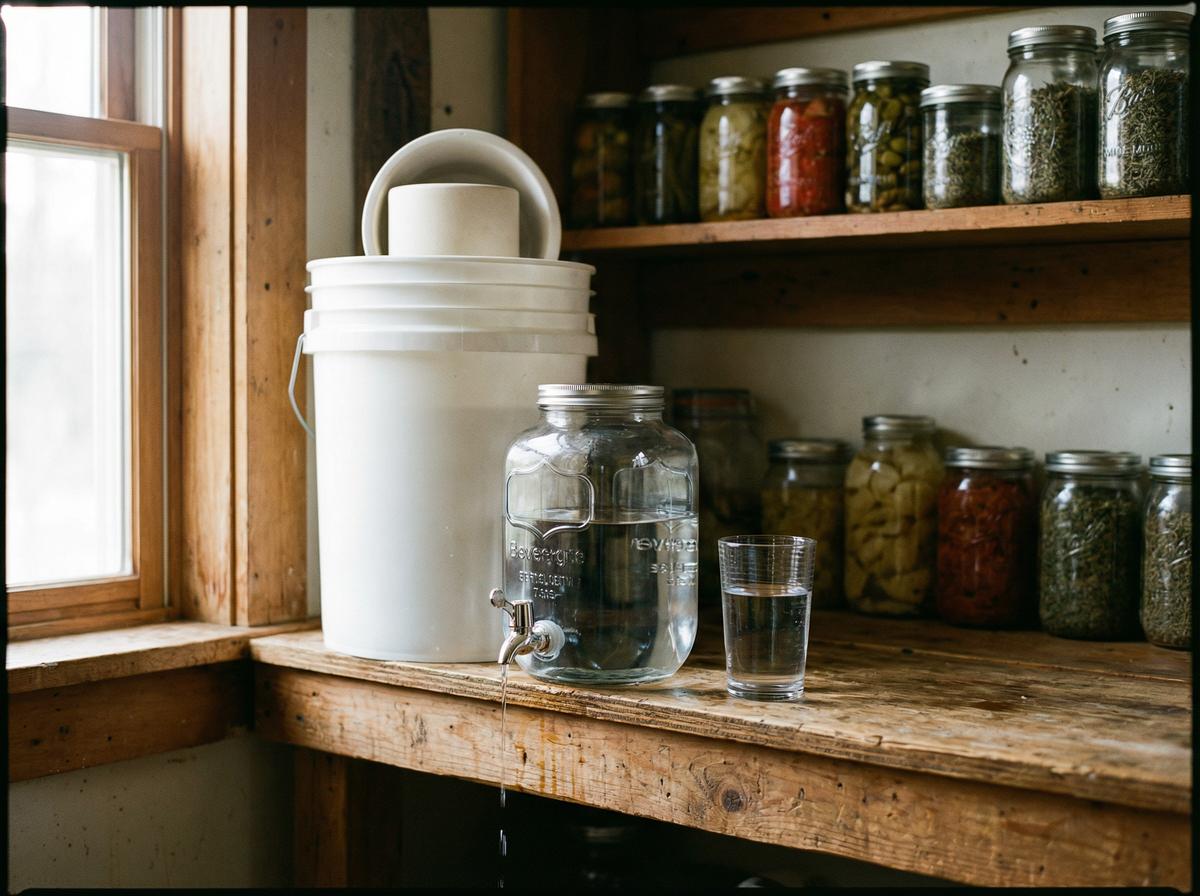
Set up a gravity-fed filtration system using ceramic or carbon filters (like a Berkey or a DIY equivalent using two food-grade buckets).
For long-term storage, treat the water with unscented household bleach — 8 drops per gallon — or calcium hypochlorite granules to prevent bacterial growth.
Always filter stored water before consumption, especially if it has been sitting for more than a week.
Building Long-Term Water Resilience
A basic catchment system is just the beginning of true water independence.
Once you have your primary system in place, you can expand your capabilities in three critical directions.
1. Develop Redundant Sources
Don’t rely solely on rainwater. Identify local natural water sources like creeks, springs, or ponds, and learn how to safely harvest and transport that water using hand pumps or gravity-fed hoses.
The experts at Survival Stronghold offer advanced strategies for securing off-grid water resources and building comprehensive preparedness systems that go far beyond a single rain barrel.
2. Master Advanced Purification and Storage
Learn how to build bio-sand filters using gravel, sand, and activated charcoal — the same technology used by frontier homesteaders and still effective today.
For comprehensive guides on off-grid living, water storage, and homesteading skills, explore the resources at Homesteader Depot.
And if you want to integrate your water system with a productive food garden — so every drop you collect goes directly toward feeding your family — the 4 Foot Farm Blueprint provides a proven system for maximizing yields in minimal space.
3. Protect Your Health at Every Level
Clean water is the foundation of health, but you must also be prepared for the medical realities of a grid-down scenario.
Freedom Health Daily and Freedom Health Alerts offer vital, actionable information on maintaining wellness when conventional medical systems are unavailable.
For natural, holistic approaches to immune resilience and long-term health, visit Seven Holistics.
The Bigger Picture: Why This Matters Right Now
The Angkor engineers didn’t fail because they lacked intelligence.
They failed because they built a system too complex to maintain — and then stopped maintaining it.
America’s water infrastructure is following the same arc.
The American Downfall analysis of this infrastructure crisis is worth reading in full — it traces the exact historical parallel between Angkor’s hydraulic collapse and the state of America’s water systems today.
And if you want to understand the economic and financial patterns that always accompany infrastructure decline, The Pattern Ledgers documents those cycles with hard data.
For premium, actionable preparedness intelligence delivered directly to your inbox, subscribe to The Ready Report.
The difference between the Angkor engineers and the American frontier homesteader was simple: one group controlled their own water supply, and one group depended on a system they couldn’t maintain.
You already know which group you want to be in.
Start this weekend.
For more deep-dive strategies on building a resilient, independent life, continue reading the Self Reliance Report.
The empire may crumble, but your homestead doesn’t have to.