


The Mughal Empire once controlled 25% of global GDP, making it the wealthiest superpower on earth.
Then, one emperor chose endless war over economic sanity.
He squeezed his citizens dry with crushing taxes to fund military campaigns, destroying the agricultural base that made the empire prosperous.
Within a decade of his death, the entire system disintegrated.
Today, we are watching a similar exhaustion of the American economic engine.
As inflation crushes households and the national debt spirals past $34 trillion to fund endless overseas conflicts, the parallels are undeniable.
When the treasury empties, the empire falls.
But while the political class argues over the ashes, you have a choice to make.
You can go down with the ship, or you can start building your lifeboat.
The Historical Parallel: How Ordinary People Survived the Last Collapse
When an empire bleeds its treasury dry, the central government always turns on its own citizens to make up the difference.
During the collapse of the Mughal Empire, the elites in the capital were paralyzed by infighting.
They raised taxes to impossible levels, confiscating the wealth of the working class to fund their endless wars.
The people who survived weren’t the politicians or the wealthy merchants tied to the state.
They were the local producers, the farmers, and the self-reliant communities who didn’t depend on the central government for their survival.
We saw the exact same dynamic during the Great Depression in America.
When the banking system failed and the government couldn’t provide a safety net, the families who thrived were the ones who had already built a household financial fortress.
They didn’t rely on a single paycheck from a fragile corporation.
They produced their own food, repaired their own tools, and traded skills within their local community.
They understood that true wealth isn’t measured in fiat currency—it’s measured in tangible assets and productive capacity.
During the 1930s, the families that survived the economic devastation didn’t do it by hoarding cash under their mattresses.
They did it by drastically reducing their dependence on the external economy.
They practiced what economists call “household import substitution.”
Instead of buying soap, they made it from lye and animal fat.
Instead of buying new clothes, they patched and repurposed the old ones.
Instead of buying expensive, imported food, they grew calorie-dense crops in their backyards and preserved them for the winter.
They insulated themselves from the macroeconomic chaos by creating micro-economies within their own property lines.
This wasn’t just a survival tactic; it was a profound act of rebellion against a system that had failed them.
By refusing to participate in the consumer economy, they starved the beast and secured their own independence.
Today, as our own empire bleeds itself dry, we must adopt this exact same mindset.
We must stop viewing ourselves as consumers and start viewing ourselves as producers.
Every dollar you don’t have to spend at the grocery store or the hardware store is a dollar that stays inside your household fortress.
It is a dollar that cannot be taxed, inflated away, or confiscated by a desperate government.
The Teachable Strategy: Build a Perpetual Calorie Engine
The most critical skill you can develop right now is Household Import Substitution.
This is the exact strategy used by Depression-era families to survive economic collapse.
Instead of trying to earn more rapidly devaluing dollars to buy expensive goods, you systematically replace the things you buy with things you produce.
The easiest and most impactful place to start is by building a Perpetual Calorie Engine—specifically, a high-yield sprouting and microgreen system.
Why sprouts and microgreens?
Because when the supply chain snaps, fresh, nutrient-dense food is the first thing to disappear from the shelves.
Canned goods and freeze-dried meals will keep you alive, but they won’t keep you healthy.
You need living enzymes, vitamins, and minerals to maintain your physical and mental resilience during a crisis.
A Perpetual Calorie Engine requires almost no space, costs pennies to start, and produces nutrient-dense food year-round, regardless of the weather or the supply chain.
You don’t need acres of land, expensive grow lights, or a background in agriculture.
You just need a few glass jars, some water, and the right seeds.
In a matter of days, you can transform a handful of dormant seeds into a massive volume of living food.
This is the ultimate form of household import substitution.
You are taking a process that normally requires massive industrial farms, diesel-powered tractors, cross-country trucking, and refrigerated grocery aisles, and you are bringing it entirely within the walls of your own home.
You are cutting out the middlemen, the taxes, and the inflation.
You are taking direct control of your own sustenance.
Step-by-Step: How to Build Your Perpetual Calorie Engine This Week
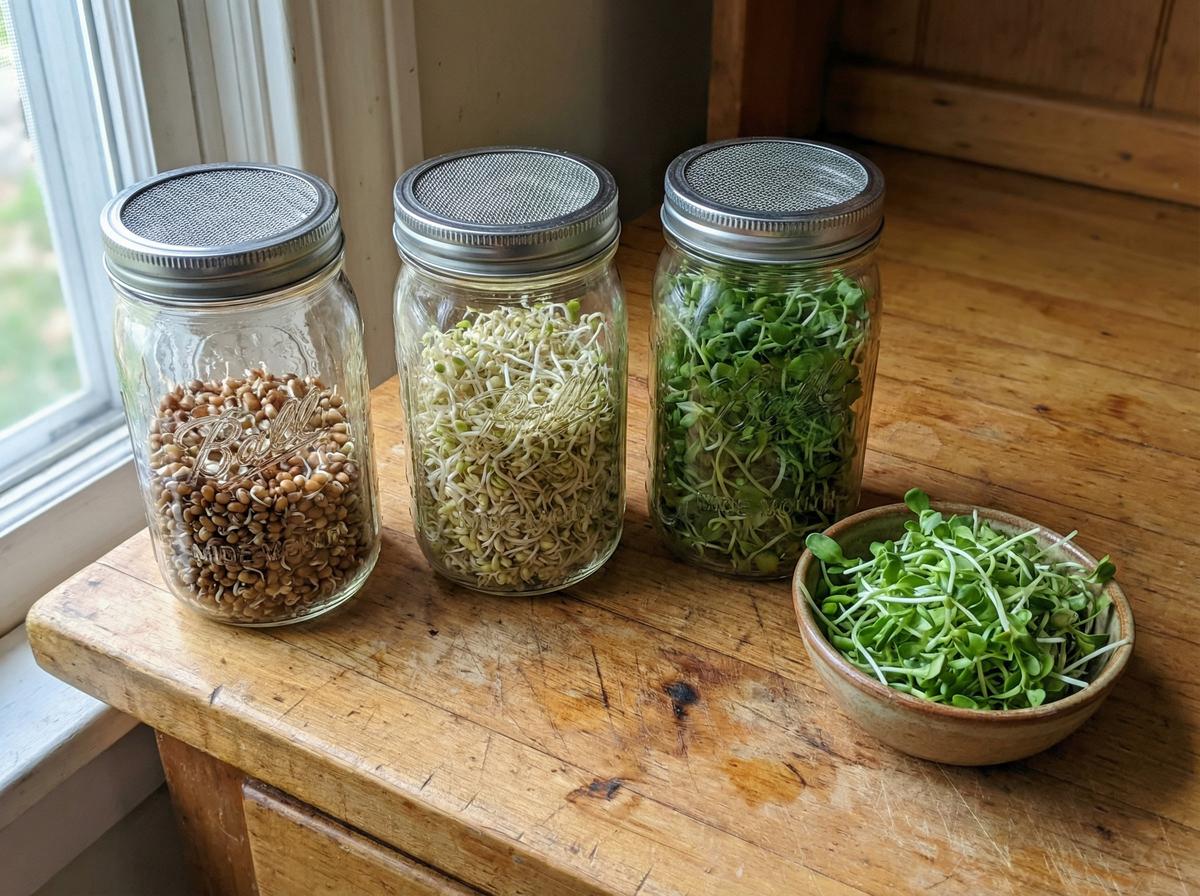
Here is exactly how to build your Perpetual Calorie Engine this week.
Materials List
| Item | Cost Estimate | Notes |
|---|---|---|
| Wide-mouth Mason jars (quart) | $8–12 for 4-pack | Ball or Kerr brand |
| Sprouting lids (mesh screens) | $8–15 for 6-pack | Or use cheesecloth + rubber bands |
| Organic sprouting seeds (alfalfa, broccoli, radish, or mung) | $8–15 per lb | Must be labeled for sprouting — not treated agricultural seed |
| Filtered water | Minimal | Avoid heavily chlorinated tap water |
Step 1: Gather Your Materials
You need wide-mouth Mason jars (quart size is ideal), sprouting lids or cheesecloth, and organic sprouting seeds.
Alfalfa, broccoli, radish, and mung beans are excellent choices for beginners.
Make sure you buy seeds specifically labeled for sprouting, as agricultural seeds are often treated with fungicides.
Step 2: The Initial Soak
Sanitize your Mason jars thoroughly with hot, soapy water.
Place two tablespoons of your chosen seeds into a clean jar.
Cover the seeds with about two inches of cool, filtered water.
Do not use tap water if it is heavily chlorinated, as chlorine can inhibit germination.
Place the jar in a dark, room-temperature location, like a kitchen cabinet.
Let the seeds soak overnight, or for 8 to 12 hours.
This soaking process wakes the seeds from dormancy and triggers the germination process.
Step 3: The First Rinse and Drain
In the morning, remove the jar from the cabinet.
Invert the jar over the sink and let all the soaking water drain out.
Fill the jar with fresh, cool water, swirl it around to rinse the seeds, and drain it again.
You must drain the jar completely.
Any standing water left in the jar will cause the seeds to rot.
Once drained, invert the jar at a 45-degree angle in a bowl or a dish rack.
Airflow is absolutely critical to prevent mold and bacterial growth.
Step 4: The Daily Maintenance Cycle
For the next several days, rinse and drain the seeds twice a day — once in the morning and once in the evening.
Keep the jars out of direct sunlight during this phase.
Within 24 to 48 hours, you will see tiny white tails emerging from the seeds.
This is the taproot, and it means your Perpetual Calorie Engine is running.
Step 5: The Greening Phase
By day four or five, move the jars to a location with bright, indirect sunlight.
Do not put them in direct, hot sun, or you will cook them.
The indirect light will trigger chlorophyll production.
Over the next 24 hours, those pale leaves will turn a vibrant, healthy green.
By day six, you will have a jar packed with fresh, living food.
Step 6: Harvest, Store, and Rotate
Once the sprouts are green and leafy, give them one final, thorough rinse.
Spread them out on a clean kitchen towel and let them air dry completely.
Once dry, place them in a sealed container in the refrigerator — they will keep for up to a week.
Immediately wash the empty Mason jar and start a new batch of seeds.
By staggering three or four jars — starting a new one every two days — you create a continuous, daily harvest.
You have successfully built a Perpetual Calorie Engine.
Longer-Term Strategies: Expanding Your Household Fortress
Building a Perpetual Calorie Engine is just the first step in securing your household fortress.
It proves that you can produce high-value resources independently of the fragile supply chain.
But to truly insulate yourself from the collapse of the empire, you must expand your self-reliance across every critical area of your life.
1. Secure Your Health Independence
When the economic engine stalls, the medical supply chain is often the first to break.
You cannot rely on fragile pharmacies for your well-being.
Start building a natural medicine cabinet today.
Learn the herbal remedies that kept our ancestors healthy long before modern pharmaceuticals existed.
Discover the foundational protocols at Seven Holistics and stay informed on emerging health threats with Freedom Health Alerts.
For daily, actionable advice on maintaining your physical resilience, read Freedom Health Daily.
2. Expand Your Food Production
Sprouts are the beginning, but true food security requires scale.
You don’t need hundreds of acres to feed your family.
You need smart, high-density growing systems.
Learn how to maximize your yield in minimal space with the 4 Foot Farm Blueprint.
Equip yourself with the right tools, heritage seeds, and off-grid supplies from Homesteader Depot.
The more calories you can produce on your own property, the less vulnerable you are to hyperinflation at the grocery store.
3. Build Tangible Wealth and Security
As the government prints more money to fund its endless wars, your savings are being silently confiscated through inflation.
You must transition your wealth into tangible assets and practical skills.
Understand the macroeconomic patterns driving this collapse at The Pattern Ledgers.
Stay ahead of the political and societal fallout by reading American Downfall.
Finally, ensure your physical location is secure.
When the economy fails, crime rises.
Learn advanced defensive strategies at Survival Stronghold and get premium, deep-dive preparedness intelligence from Ready Report.
The empire may be bleeding itself dry, but your household doesn’t have to.
You have the power to build a fortress that can withstand the coming storm.
Start building your lifeboat today.
Read more practical guides right here at the Self Reliance Report.