
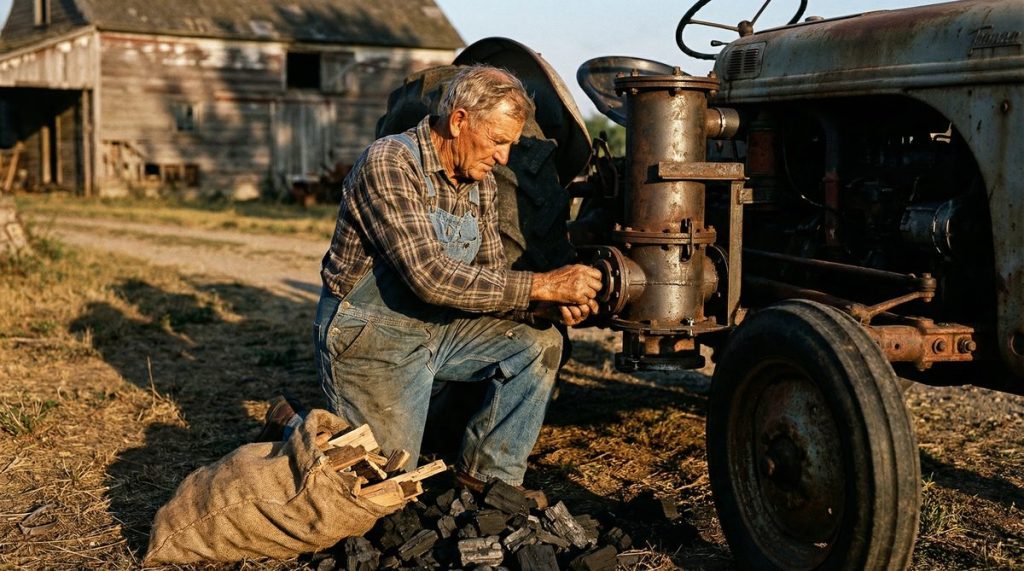
The fragility of global energy supply lines is a stark reality — a Majapahit Warning echoing from history that critical chokepoints can dictate the fate of nations and individuals. When the global flow of oil falters, due to geopolitical tensions or natural disaster, the modern world grinds to a halt. This underscores why true self-reliance in energy is not a fringe idea but an absolute necessity for every preparedness-minded citizen. Our personal energy independence safeguards our homes, keeps our systems running, and ensures our families can thrive — even when the broader grid falters.
The Historical Parallel: When Europe Ran Out of Gas
People just like us have faced severe energy shortages before, and their resourcefulness holds invaluable lessons for today.
During the Great Depression, rural Americans — already masters of making do — repurposed farm equipment and scavenged what they could, often relying on muscle power and animal labor when fuel for their tractors became a luxury.
Yet it was during World War II, particularly in blockaded Europe and fuel-rationed America, that necessity truly birthed invention — compelling ordinary citizens to embrace radical alternative fuel solutions.
Gas rationing hit hard. Private vehicle use was severely curtailed. Industries scrambled for any available power. Farmers couldn’t run their combines. Delivery trucks couldn’t make their rounds. Even emergency services faced restrictions.
In Sweden, nearly 90% of all vehicles were converted to run on wood gas — a technology born of desperation but refined into a surprisingly efficient alternative.
Across Europe, resourceful mechanics and farmers built simple “gas producers” from old oil drums, steel pipes, and even ceramic crocks — feeding them wood scraps to generate combustible gas. They understood that adaptability was survival. They meticulously collected wood, processed it into charcoal, and maintained their improvised systems with a level of dedication that defined their era.
These were not government initiatives alone. These were grassroots efforts by ordinary people determined to keep their lives moving — proving that a local fuel source is the most reliable one when global supplies dry up.
Their legacy is a testament to the power of human ingenuity when confronted with an existential threat — showing us that energy independence is always within reach for those willing to learn and build.
The Teachable Strategy: Building a Simple Charcoal Gasifier
One powerful skill resurrected from that era — highly actionable today with minimal equipment — is building a simple charcoal gasifier.
While full wood gasifiers can be complex (producing tar and requiring extensive filtering), a charcoal gasifier offers an accessible entry point into alternative fuel production.
It harnesses the power of readily available biomass — specifically wood charcoal — to produce a clean-burning synthetic gas (“producer gas”) capable of fueling small internal combustion engines, generators, or even providing heat.
This isn’t theoretical. This is a proven, wartime technology that powered vehicles and farm machinery when gasoline was impossible to acquire.
The beauty of the charcoal gasifier lies in its simplicity: a robust, well-filtered gas suitable for engines — without the heavy tar associated with raw wood gasification.
By mastering this skill, you gain the ability to power essential equipment using a sustainable, self-renewable fuel source found in your own backyard or local forest. Keeping your generator running. Your well pump operating. Your tools powered — all fueled by charcoal you made yourself.
This skill is a cornerstone of true self-reliance — offering a tangible path to energy independence starting this week.
Step-by-Step: Build Your Own Charcoal Gasifier
Here’s how to construct a basic charcoal gasifier for powering a small generator (500W–2kW setups work best with these simpler builds).
Materials List
- One 55-gallon steel drum (outer shell)
- One 30-gallon steel drum (inner reactor)
- Steel plate for a grate (1/4″ thick, drilled with 1/2″ holes)
- Steel pipe, 1–2 inch diameter (for air inlet and gas outlet)
- Basic welding or fastening equipment
- Air blower (a leaf blower works for startup)
- Filtering material: wood shavings, rock wool, or baled hay
- Hardwood charcoal (oak, maple, hickory — no treated wood)
Instructions
- Make your charcoal first. Burn hardwoods in a retort or simple pit kiln until fully carbonized. Avoid treated wood or resin-heavy softwoods. Your gasifier is only as clean as its fuel.
- Construct the reaction chamber. Place the smaller 30-gallon drum inside the larger 55-gallon drum, centered, leaving an air gap around it. The inner drum is your reactor. The space between the drums serves as an initial cooling zone.
- Build the hearth and grate. Cut a circular opening near the bottom center of the inner drum. Weld or bolt your steel grate over this opening. It supports the charcoal and lets ash fall through. Create an airtight ash pit access door on the outer drum for periodic cleaning.
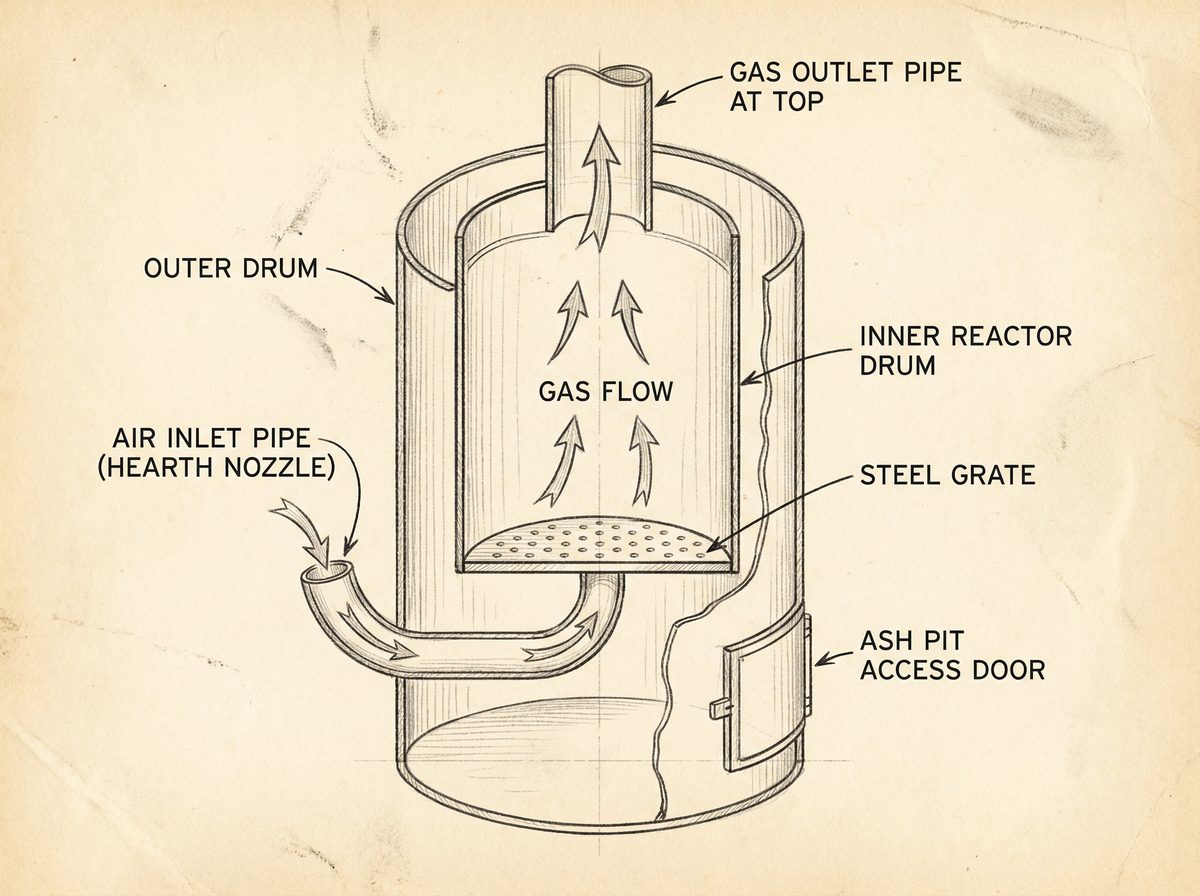
- Install the air inlet (hearth nozzle). Drill a hole through the outer drum, through the air gap, and into the side of the inner drum’s reactor — just above the grate level. Fit a steel pipe, angled slightly downward, into this hole, extending a few inches into the reactor. This is where primary combustion air enters. Ensure all pipe connections are airtight.
- Create the gas outlet. Near the top of the inner drum, cut a hole and install another steel pipe. Route this pipe through the outer drum’s top or side. The gas will be hot — it needs cooling and filtering before reaching your engine.
- Build the cooling and filtering system. Connect the gas outlet pipe to a series of simple stages:
- Cooling coil: Coil your gas outlet pipe through a bucket of water to drop the temperature.
- Cyclonic separator (optional but recommended): A small drum with a tangential inlet to spin out heavier particulates.
- Hay/fiber filter: A container packed with wood shavings or rock wool to catch finer particles.
- Moisture trap: A final chamber with a drain valve to collect condensation.
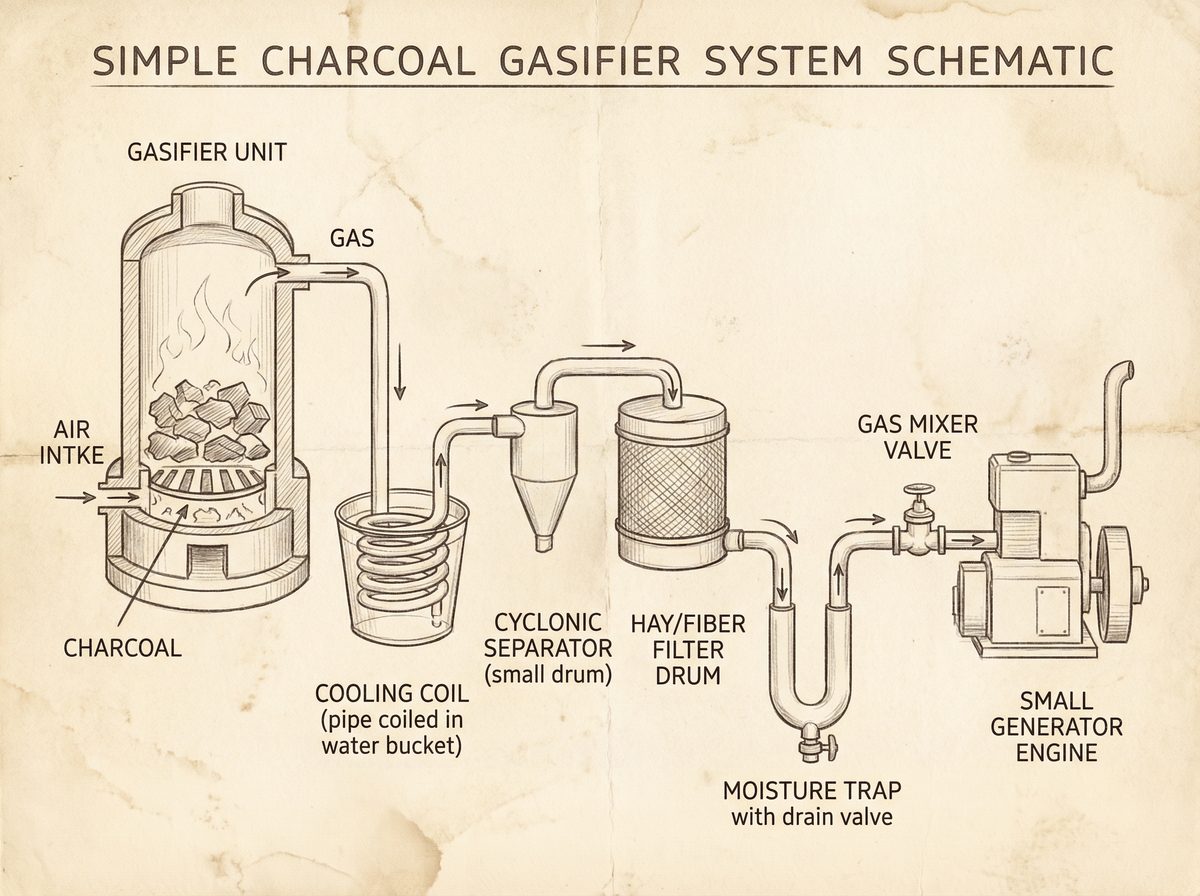
- Connect and test. Connect the final filtered gas outlet to your generator’s air intake (you may need to adapt the carburetor or use a specialized mixer valve). Load the reactor with charcoal, light it from the top with a propane torch or kindling, and use your blower to draw air through the hearth. After a few minutes, rich gas should emerge from the outlet. Ignite it safely with a torch — it should burn with a clean, blue flame.
- Safety first — always. Operate outdoors in a well-ventilated area to avoid carbon monoxide poisoning. Have a fire extinguisher handy. Wear appropriate PPE. Start with small amounts of charcoal and scale up once familiar with the process. Never run a gasifier indoors or unattended.
Longer-Term Strategies: Building Your Energy Independence Stack
Mastering the charcoal gasifier is just the first step on a lifelong journey toward complete energy independence and resilience.
Strategy 1 — Cultivate a sustainable fuel source. A gasifier is only as good as its fuel. Consider establishing coppicing woodlots on your property or building relationships with local landowners for sustainable timber harvesting. Learning about sustainable food and land production through resources like the 4 Foot Farm Blueprint can provide not just sustenance but also fast-growing biomass for charcoal production — transforming your land into a self-renewing energy reservoir.
Strategy 2 — Diversify your energy stack. Wood gas is excellent for mechanical power, but don’t stop there. Combine it with passive solar design for heating and cooking, small-scale wind turbines, or micro-hydro systems if you have a suitable water source. Every layer you add to your energy independence fortress makes your family more resilient. Explore comprehensive preparedness strategies at Survival Stronghold and stay current with evolving threats through The Ready Report.
Strategy 3 — Build community knowledge networks. True self-reliance isn’t just about individual skills — it’s about collective resilience. Share your gasifier build with neighbors. Host a skills workshop. The more people in your community who can produce their own fuel, the stronger everyone’s position becomes when supply chains tighten. Your physical and mental well-being are paramount to sustaining this kind of demanding, hands-on lifestyle. Prioritize your health with holistic wellness strategies at Seven Holistics, stay sharp with daily health insights from Freedom Health Daily, and subscribe to critical health alerts at Freedom Health Alerts.
For the essential tools and components you’ll need to build your gasifier and expand your homestead energy systems, Homesteader Depot is your go-to resource. To understand the deeper economic and historical patterns driving today’s energy vulnerabilities — including why chokepoints like the Strait of Hormuz matter so much — The Pattern Ledgers provides the analytical framework you need. And for the full picture of what’s driving these crises at the societal level, American Downfall is where you’ll find the unfiltered analysis.
The Majapahit Warning is not a prophecy of doom. It’s an urgent call to action.
Relying solely on fragile global supply chains is a gamble no prepared individual should take. By learning skills like building a charcoal gasifier and embracing a multi-faceted approach to self-reliance, you are not just preparing for a crisis — you are building a more secure, independent, and resilient future for yourself and your loved ones.
For a deeper dive into energy independence and many other critical preparedness topics, explore the extensive resources right here on Self Reliance Report.
The time to act is now.