
Right now, the United States is spending more money to service its national debt than it spends on its entire military.
Interest payments on the national debt are set to surpass $1 trillion in 2026.
That is $88 billion a month.
We are watching the financial exhaustion of a superpower in real-time.
But this is not the first time a global hegemon has spent itself into a corner where its debt eclipsed its defense.
When empires collapse under the weight of their own debt, the burden always falls on the citizens.
Taxes rise.
Inflation destroys purchasing power.
The cost of basic survival skyrockets.
If you rely entirely on the system to feed your family, you are completely exposed to its financial failures.
You need a buffer.
You need a household financial fortress.
The Historical Parallel: The Spanish Empire’s Fiscal Collapse
In the 16th century, Spain was the undisputed master of the world.
Under King Philip II, the Spanish Empire stretched from the Americas to the Philippines.
They controlled the oceans.
They commanded the most feared military force on earth.
And they had a seemingly endless supply of wealth pouring in from the silver mines of the New World.
But they also had a spending problem.
To fund a global military footprint, Philip borrowed on an unprecedented scale.
He mortgaged the future of the empire to pay for the wars of the present.
By the late 16th century, debt servicing was consuming between 40% and 50% of the Spanish crown’s annual revenue.
To keep the machine running, Philip II introduced a crushing new tax called the millones.
It targeted basic foodstuffs — wine, meat, vinegar, and oil.
It devastated the working class, driving up the cost of living and destroying the domestic economy.
The citizens who survived this era of crushing taxation and inflation were the ones who produced their own food.
They didn’t rely on the crown’s markets.
They built local resilience.
They insulated themselves from the empire’s debt by reducing their own dependency on the system.
The Teachable Strategy: The Bulk Calorie Buffer
When the cost of living spikes due to national debt crises, the most immediate impact is at the grocery store.
The single most effective way to insulate your household from this inflation is to build a Bulk Calorie Buffer.
This isn’t about buying expensive freeze-dried survival meals.
This is about strategically acquiring and storing base ingredients that provide maximum caloric value for the lowest possible cost.
By securing a six-month supply of foundational calories at today’s prices, you create a financial shock absorber for your family.
When food prices jump 20% next year, your core food costs remain locked at today’s rates.
This is how you fight inflation on a household level.
Step-by-Step Instructions: Building Your Buffer
Here is exactly how to build your Bulk Calorie Buffer this weekend.
Step 1: Calculate Your Baseline Needs
The average adult requires roughly 2,000 calories per day.
For a family of four, that is 8,000 calories daily, or 240,000 calories per month.
Your goal is to secure at least half of these calories through bulk dry goods.
Step 2: Source the Core Four
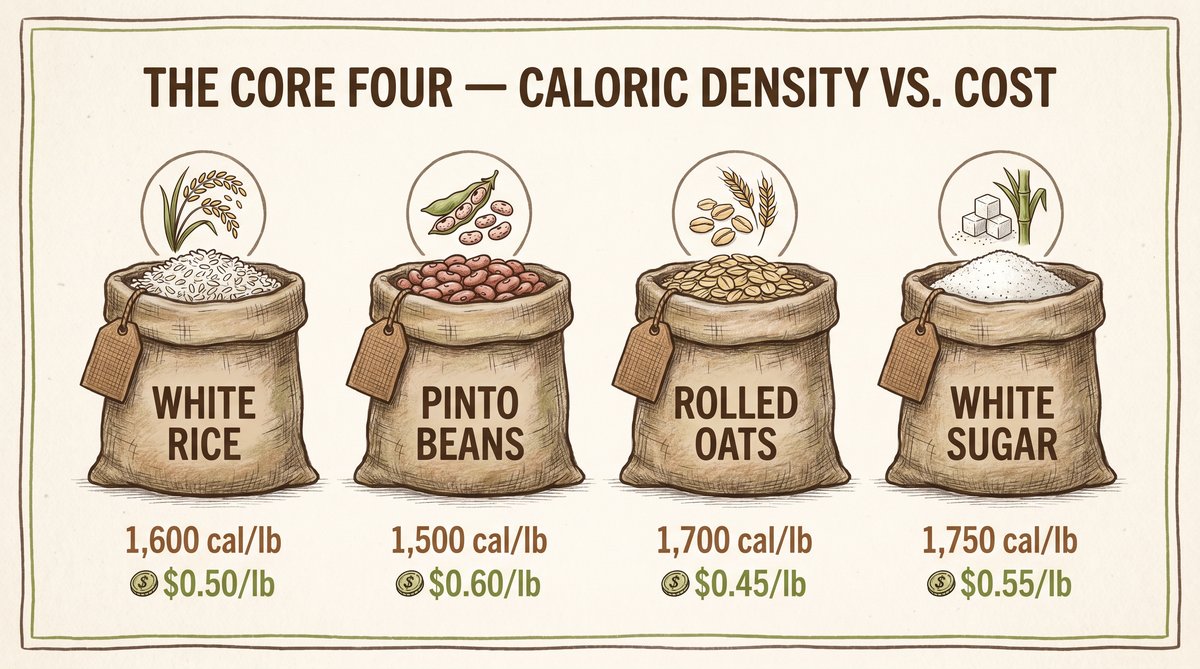
Focus entirely on the “Core Four” survival staples: Rice, Beans, Wheat (or Oats), and Sugar (or Honey).
These items offer the highest caloric density per dollar.
Do not buy these at a standard grocery store.
Go to a restaurant supply store, a local mill, or a bulk agricultural supplier.
Purchase them in 25-pound or 50-pound bags.
Step 3: The Mylar and Oxygen Absorber Method
Bulk goods stored in their original paper or plastic sacks will attract pests and spoil.
You must repackage them for long-term storage.
Purchase 5-gallon Mylar bags and 2000cc oxygen absorbers.
Place the Mylar bag inside a food-grade 5-gallon bucket.
Fill the bag with your bulk grain or beans.
Drop in one 2000cc oxygen absorber.
Immediately seal the top of the Mylar bag using a household iron or a dedicated impulse sealer.
Leave a small two-inch gap, press out as much air as possible, and seal the rest.
Step 4: Label and Rotate
The oxygen absorber will consume the remaining oxygen, creating a vacuum seal that prevents pest infestation and oxidation.
Seal the bucket with a tight-fitting lid.
Label the outside of the bucket with the contents, the date packed, and the total caloric value.
Store these buckets in a cool, dark, dry location.
This is your financial fortress.
The Mathematics of Household Resilience
Let’s break down the exact math of why this strategy works so effectively.
When you purchase a 50-pound bag of rice from a restaurant supply store, you are typically paying around $20 to $25.
That single bag contains approximately 80,000 calories.
If you were to purchase those same 80,000 calories in the form of pre-packaged, processed foods at a standard grocery store, you would easily spend over $200.
You are achieving a 10x return on your caloric investment simply by changing how and where you buy your foundational foods.
This is the secret that the Spanish working class discovered during the millones tax crisis.
They realized that the empire’s inflation only affected those who participated in the empire’s markets.
By stepping outside the standard consumer supply chain, you instantly insulate yourself from the price shocks that devastate the middle class.
The Psychological Advantage of the Buffer
Beyond the pure financial mathematics, there is a profound psychological advantage to building a Bulk Calorie Buffer.
When the news cycle is dominated by trillion-dollar deficits, failing banks, and geopolitical instability, the natural human response is anxiety.
This anxiety drives poor decision-making.
It causes people to panic-buy at the worst possible times, paying premium prices for subpar goods.
When you have six months of foundational calories secured in your home, that anxiety evaporates.
You no longer watch the grocery store prices with a sense of dread.
You watch them with the calm detachment of someone who has already solved the problem.
This mental clarity is your greatest asset in a crisis.
It allows you to focus your energy and resources on higher-level preparations, rather than scrambling for basic survival needs.
Longer-Term Strategies for Total Independence
Building a Bulk Calorie Buffer is your immediate defense against the empire’s debt crisis.
But true self-reliance requires a multi-layered approach.
Once your baseline calories are secured, you must expand your independence.
1. Cultivate Your Own Supply Lines
You cannot store enough food forever. Eventually, you must produce it.
Start by learning the principles of high-yield, low-space food production.
The experts at 4 Foot Farm Blueprint have mastered the art of generating massive caloric yields from minimal square footage.
This is how you transition from storing food to creating it.
2. Secure Your Health Independence
When national budgets collapse, public services and healthcare systems are the first to degrade.
You must take radical ownership of your family’s physical well-being.
Begin integrating natural, preventative health strategies into your daily routine.
Resources like Seven Holistics and Freedom Health Daily provide the foundational knowledge needed to maintain vitality outside the medical-industrial complex.
For urgent updates on medical supply chain vulnerabilities, monitor Freedom Health Alerts.
3. Build a Tangible Asset Base
Paper wealth evaporates during a sovereign debt crisis.
You need hard assets, practical skills, and off-grid infrastructure.
Equip your homestead with the tools and knowledge necessary to survive a prolonged systemic failure.
Homesteader Depot and Survival Stronghold offer the critical gear and tactical training required to defend your property and sustain your family.
Stay informed on the macro-economic shifts driving these crises by following American Downfall and The Ready Report.
And to understand the deeper historical cycles at play, study the analysis at The Pattern Ledgers.
The Final Warning
The math of the American empire is no longer sustainable.
You cannot borrow $1 trillion a year just to pay the interest on your past debts without eventually triggering a catastrophic currency devaluation.
The timeline is uncertain, but the destination is mathematically guaranteed.
Do not wait for the crisis to become obvious to the masses.
By the time the general public realizes what is happening, the restaurant supply stores will be empty, and the price of bulk goods will have doubled.
The time to build your household financial fortress is right now, while the system is still functioning and the supply lines are still open.
Take control of your household economy today.
Read more strategies for household resilience at the Self Reliance Report.