
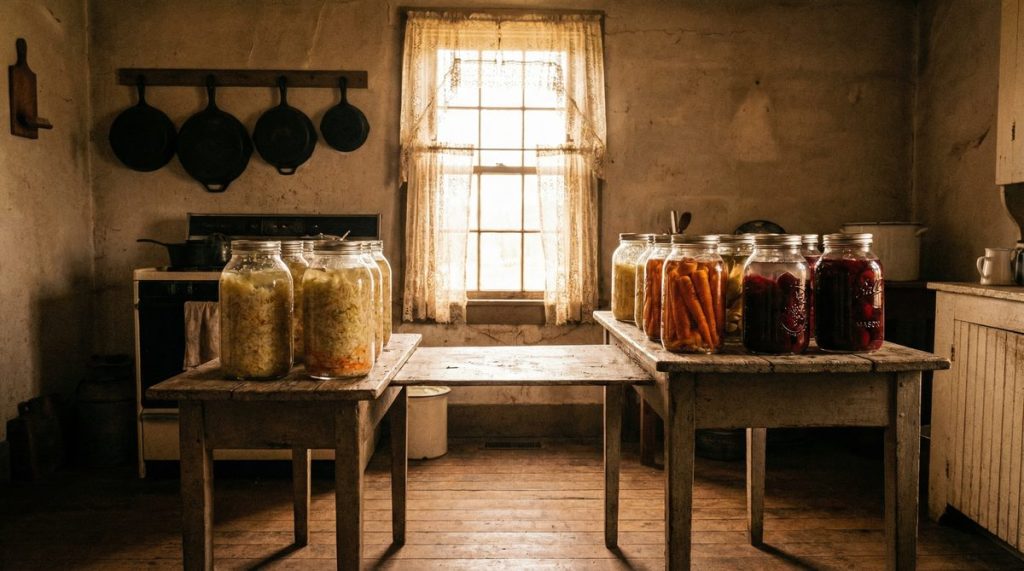
The average American grocery store carries exactly three days of inventory.
When you look at the fragility of our modern supply chain, it is terrifyingly similar to the centralized systems of the past.
The Inca Empire built the most sophisticated food supply chain in the ancient world — thousands of storehouses packed with enough food to last for years.
But when an external shock hit their system, millions starved while surrounded by their own stockpiles.
The lesson is brutal but clear: centralized storage does not save you when the distribution network collapses.
True security only exists when your food supply is decentralized, localized, and entirely under your control.
The Historical Parallel: The Great Depression’s Decentralized Survival
During the Great Depression, the centralized economic system of the United States ground to a halt.
Supply chains fractured, banks collapsed, and the distribution of goods failed on a massive scale.
Yet, millions of rural and semi-rural families survived the darkest years of the 1930s without relying on government handouts or grocery stores.
They didn’t survive because they had access to massive, centralized warehouses.
They survived because their food storage was completely decentralized.
Every home was its own processing plant, its own warehouse, and its own distribution center.
When the external shock of the Depression hit, these families relied on a network of root cellars, smokehouses, and pantry shelves lined with preserved foods.
They utilized methods that required zero electricity, zero refrigeration, and zero reliance on fragile supply chains.
One of the most critical, yet nearly forgotten, skills from this era was the art of lacto-fermentation.
Before the widespread adoption of the electric refrigerator, fermentation was a primary method for preserving the harvest through the long, brutal winters.
It is a biological preservation method that not only keeps food safe from spoilage for months — but actually increases its nutritional value.
If the grid goes down tomorrow, or if the supply chain snaps, your refrigerator becomes a useless plastic box within 48 hours.
But if you understand the science of traditional fermentation, you can preserve hundreds of pounds of food using nothing but salt, water, and time.
The Teachable Strategy: Grid-Down Lacto-Fermentation
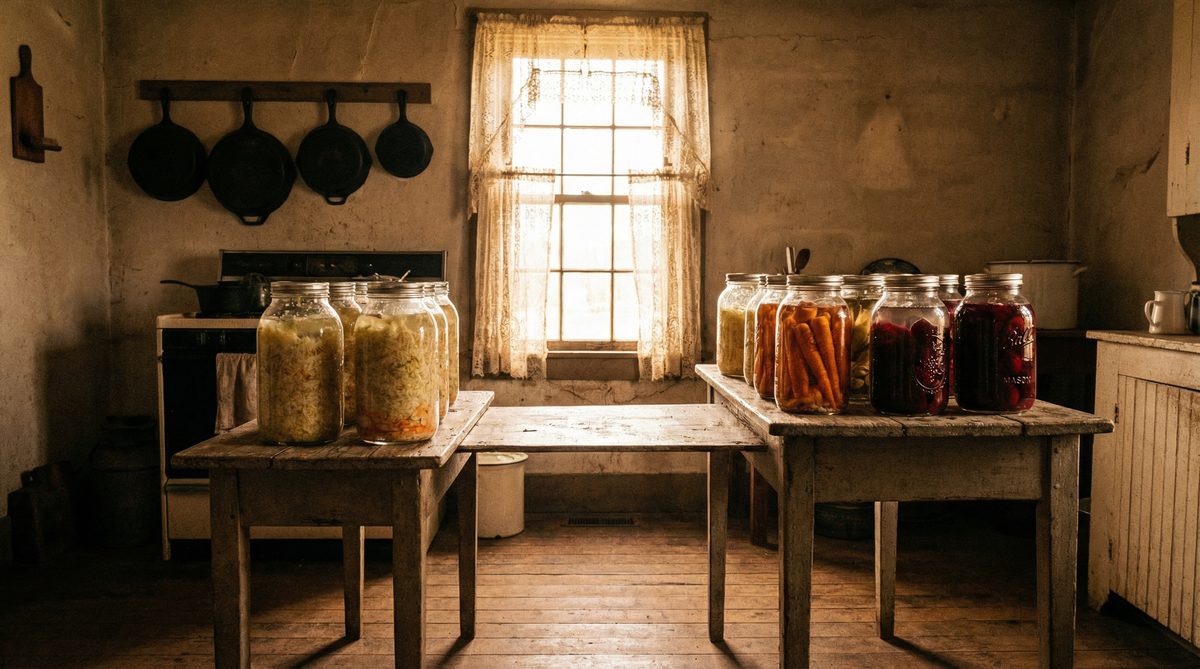
Lacto-fermentation is the process where natural bacteria (Lactobacillus) convert sugars in food into lactic acid.
This lactic acid acts as a natural preservative, inhibiting the growth of harmful bacteria and preventing rot.
It is the exact same process used by our ancestors to make sauerkraut, kimchi, and traditional pickles.
You do not need a generator, you do not need a pressure canner, and you do not need a freezer.
You only need a basic understanding of ratios and a cool, dark place to store your finished product.
This is a skill you can start practicing this week, right on your kitchen counter, with minimal equipment.
By mastering this now, you are building a decentralized food preservation system that cannot be disrupted by power grid failures or economic collapse.
Step-by-Step Instructions: Preserving the Harvest Without Power
Here is exactly how you can start preserving food today using the traditional lacto-fermentation method.
The Materials List
- Fresh, firm vegetables (cabbage is the easiest for beginners)
- Non-iodized salt (sea salt, kosher salt, or Himalayan pink salt)
- Filtered or unchlorinated water
- Large glass mason jars with lids
- A heavy object to use as a weight (a smaller glass jar works perfectly)
- A large mixing bowl
Step 1: Prepare Your Vegetables
Thoroughly wash your vegetables in clean, unchlorinated water.
Chlorine kills the beneficial bacteria needed for fermentation — if you are using city water, let it sit out for 24 hours to allow the chlorine to evaporate.
Shred or chop your cabbage thinly and uniformly. The more surface area you expose, the easier it will be to extract the natural juices.
Step 2: Apply the Salt
Place your shredded cabbage into the large mixing bowl.
The golden rule of fermentation is the ratio: you need exactly 2% salt by weight of your vegetables.
For a standard medium head of cabbage (about 3 pounds), you will need roughly 1.5 to 2 tablespoons of high-quality, non-iodized salt.
Sprinkle the salt evenly over the cabbage.
Step 3: Massage and Extract
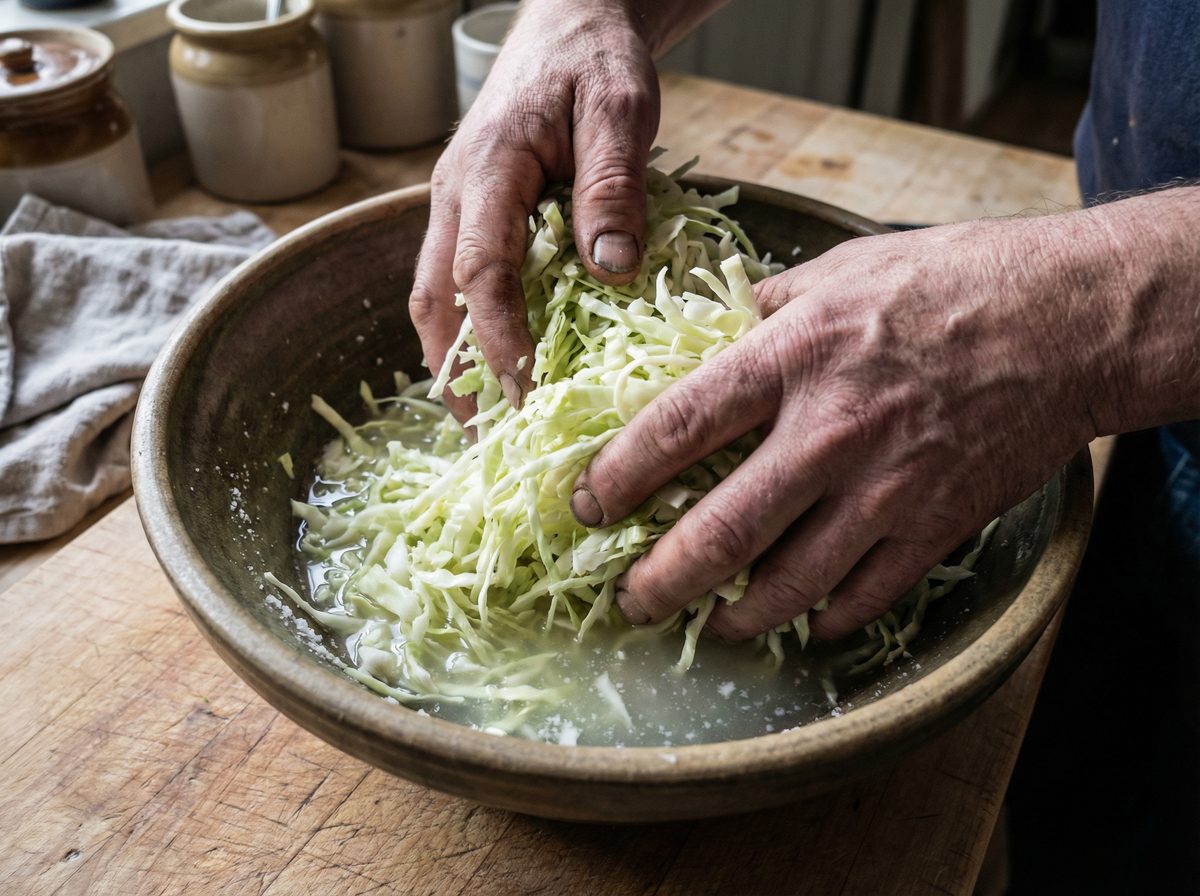
Using your clean hands, aggressively massage, squeeze, and crush the salted cabbage.
You need to break down the cellular walls of the plant.
Within 5 to 10 minutes, the cabbage will begin to release a significant amount of liquid.
This liquid is your natural brine, and it is critical for the preservation process.
Step 4: Pack the Jars
Take your clean glass mason jars and begin packing the cabbage into them tightly.
Press down firmly as you add each handful to force out any trapped air bubbles.
You want the cabbage to be completely submerged under its own liquid.
Leave about two inches of empty space (headspace) at the top of the jar to allow for expansion during fermentation.
Step 5: Weigh It Down
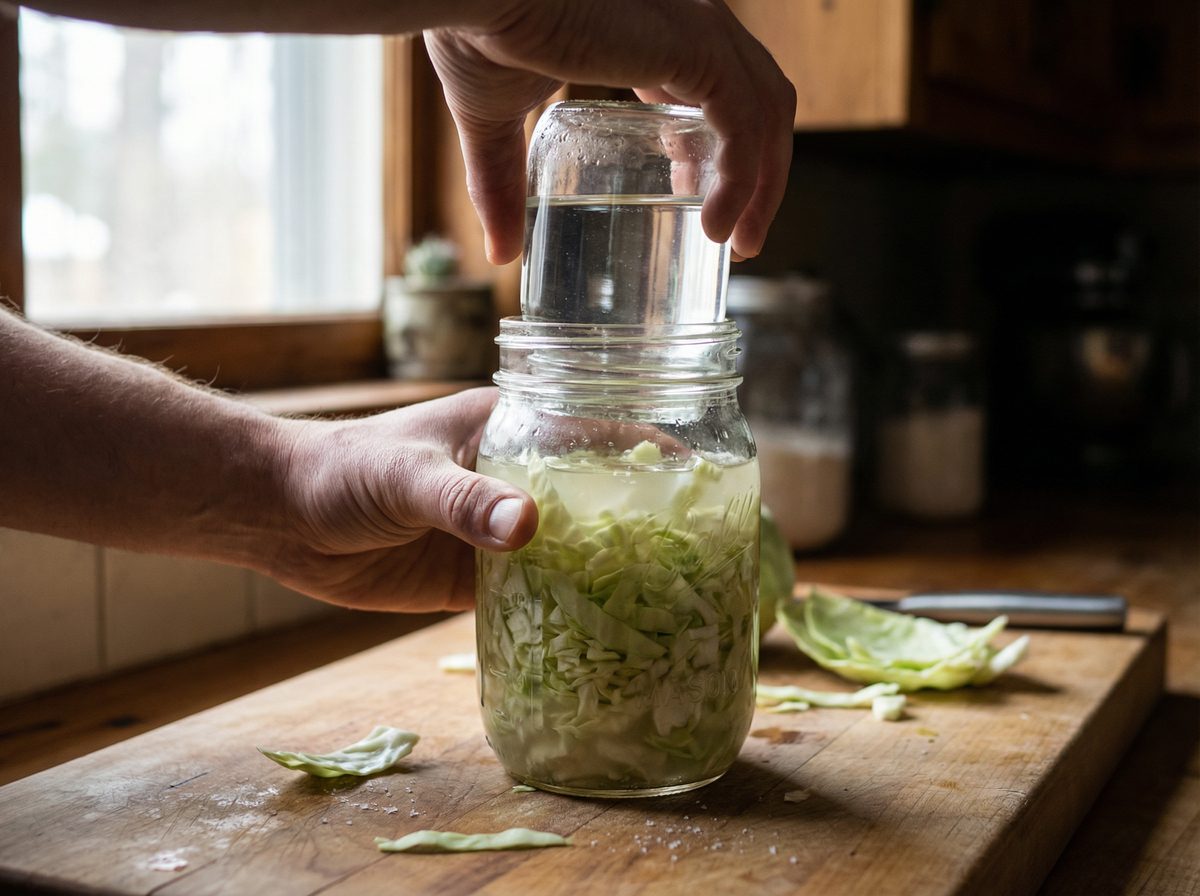
The most important rule of fermentation is: “Under the brine, all is fine.”
If any cabbage floats to the surface and touches the air, it can mold.
Place a clean, smaller glass jar (or a dedicated fermentation weight) on top of the cabbage to keep it permanently submerged under the liquid.
Step 6: The Fermentation Period
Seal the jar loosely with a lid.
Do not tighten it completely — the fermentation process will create carbon dioxide gas that needs to escape.
Place the jar in a cool, dark place, ideally between 65°F and 72°F.
Let it ferment for 1 to 4 weeks.
Taste it after the first week; when it reaches your desired level of tanginess, tighten the lid and move it to your root cellar or a cool basement for long-term storage.
Longer-Term Strategies for Total Independence
Mastering basic fermentation is just the first step in building a truly resilient, decentralized food system.
To achieve total independence from the fragile modern supply chain, you must expand your capabilities across multiple disciplines.
1. Build a Comprehensive Shadow Pantry
Fermentation preserves what you grow, but you also need a deep reserve of dry goods.
You must build a shadow pantry that can sustain your family through prolonged disruptions.
For advanced strategies on securing your home and supplies, the experts at Survival Stronghold provide critical intelligence on threat mitigation and long-term preparedness.
If you are looking for the physical tools and off-grid equipment to build out your storage infrastructure, Homesteader Depot is an essential resource for serious self-reliance gear.
And for a structured, step-by-step emergency readiness framework, The Ready Report is your complete guide to surviving the disruptions that are already underway.
2. Establish Your Own Supply Line
You cannot preserve food if you do not have a reliable source of calories.
You must start producing your own food, even if you have limited space.
The 4 Foot Farm Blueprint teaches you exactly how to generate massive caloric yields in incredibly small footprints — even in a backyard, a balcony, or a garage.
By combining high-yield micro-farming with traditional preservation skills, you completely sever your reliance on the grocery store.
To understand the broader economic forces driving these supply chain failures, read the daily briefings at American Downfall.
And to protect your wealth while the system fractures, study the financial patterns and strategies detailed at The Pattern Ledgers.
3. Prioritize Off-Grid Health and Medicine
When the supply chain breaks, the medical system breaks with it.
Your decentralized pantry must include natural medicines and health-sustaining foods.
Fermented foods are extraordinary for gut health — which is the foundation of your immune system and your first line of defense when conventional medicine is unavailable.
For deeper insights into natural remedies and holistic independence, Seven Holistics offers powerful traditional knowledge rooted in centuries of practice.
You must also stay informed on emerging health threats by following Freedom Health Alerts.
For daily, actionable advice on maintaining your physical resilience without relying on the pharmaceutical grid, read Freedom Health Daily.
The time to build your decentralized systems is right now, while the grocery stores still have their three days of inventory.
Do not wait for the external shock to hit.
Start fermenting, start storing, and take absolute control of your family’s survival.
For more daily strategies on building your independent life, keep reading the Self Reliance Report.