
The American West is running out of water.
In 2026, the Colorado River—the lifeblood for 40 million Americans—is facing a catastrophic shortfall.
Snowpack in the Rocky Mountains has hit record lows.
Federal plans to ration water are already sparking bitter legal wars between states.
Cities are imposing emergency restrictions.
Ranchers are selling off herds because they can’t water them.
But this is not just a weather problem.
It is a civilization problem.
When the water stops flowing, the infrastructure of society begins to crack.
Food prices skyrocket. Power grids fail. Populations are forced to move.
We are watching the early stages of a resource collapse.
And history tells us exactly how this ends.
The 650-Year Drought
In the 10th century, the Toltec Empire was the undisputed superpower of Mesoamerica.
Their capital, Tollan (Tula), was a marvel of engineering and wealth — home to 40,000 people, featuring massive pyramids, sprawling palaces, and complex trade networks that stretched for thousands of miles.
The Toltecs were masters of their environment.
They built sophisticated agricultural systems that produced massive yields of maize and cotton.
To the outside world, the Toltecs seemed invincible.
But their entire empire was built on a fragile foundation: predictable weather.
Around 1150 AD, the climate shifted.
A megadrought descended on the region, lasting for decades.
The rains stopped. The rivers dried up. The sophisticated agricultural systems that fed the empire collapsed.
Without food, the tribute system failed. Without tribute, the military lost its power. Without military power, the central authority crumbled.
The Toltecs didn’t fall to a foreign invader.
They fell because they ran out of water.
They were forced to abandon their magnificent capital and migrate south, becoming refugees in their own land.
They were destroyed by their reliance on a system they couldn’t control.
You can track the geopolitical and economic indicators driving today’s collapse at American Downfall.
The Frontier Solution: Decentralized Water
Fast forward to the American frontier in the 1800s.
Pioneers moving West faced the exact same arid, unforgiving environment.
But they didn’t have a centralized government to build massive aqueducts or reservoirs.
They didn’t have a municipal water supply to rely on.
They had to solve the water problem themselves.
And they did it through radical decentralization.
Every homestead, every cabin, every farm was its own water utility.
They didn’t wait for the rain to fill a distant reservoir.
They captured every drop that fell on their own property.
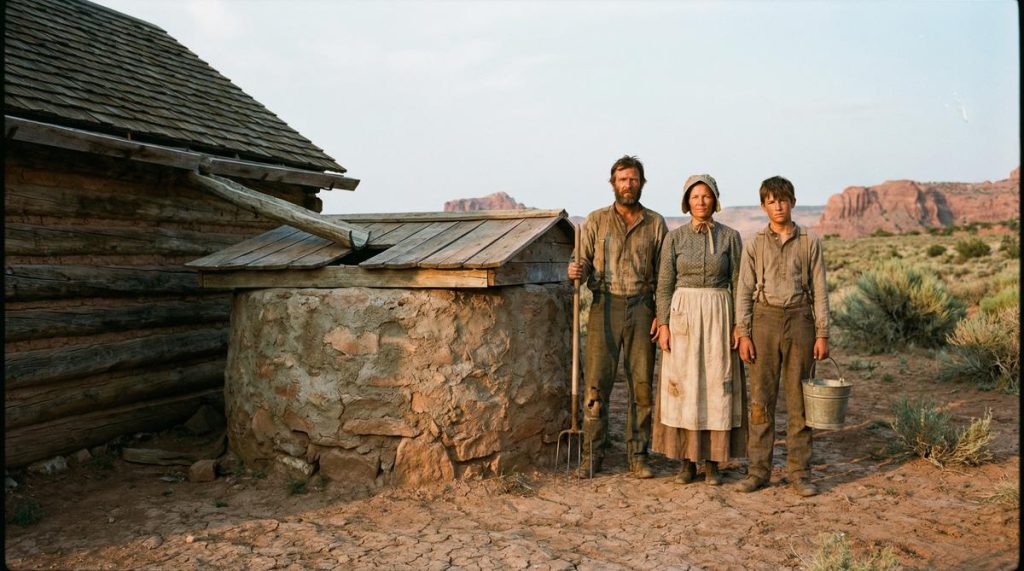
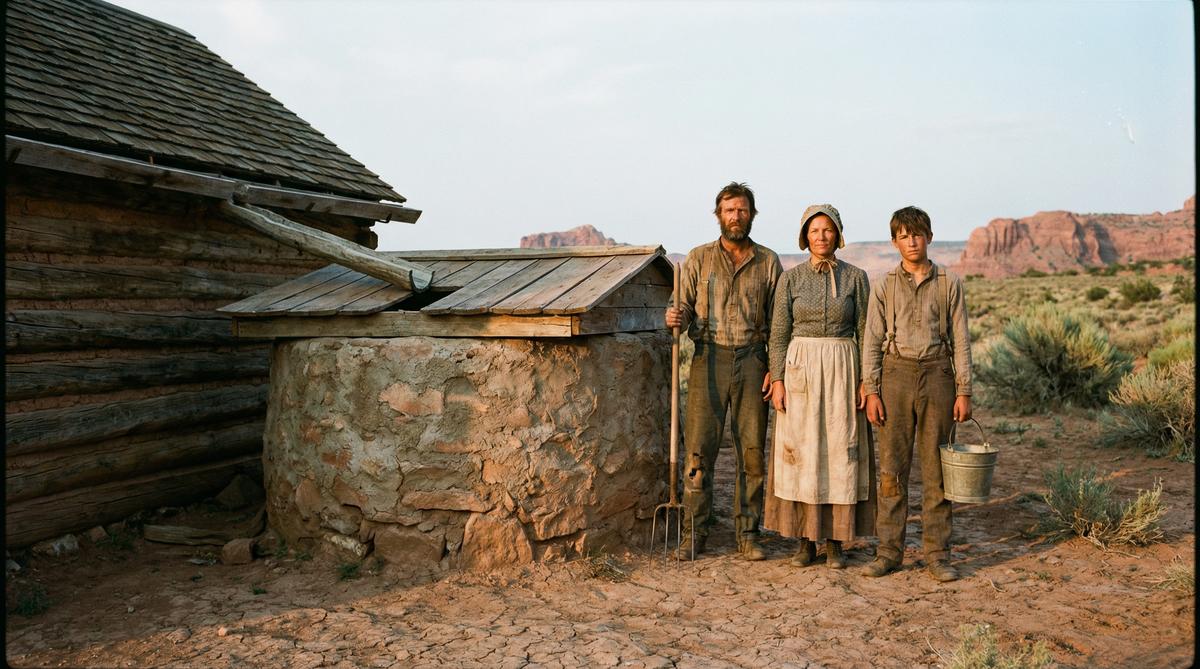
They built cisterns.
A cistern is simply a large, waterproof receptacle for catching and storing rainwater.
It’s one of the oldest and most reliable forms of water security in human history.
Frontier families would route the runoff from their roofs directly into these storage tanks.
A single inch of rain falling on a 1,000-square-foot roof yields over 600 gallons of water.
Even in a drought, a few good storms could provide enough water to sustain a family for months.
This wasn’t a hobby.
It was survival.
If your cistern ran dry, you didn’t call the city. You packed up and left. Or you died.
The Teachable Strategy: Building a Modern Cistern System
Today, we are entirely dependent on a fragile, centralized water grid.
When the municipal supply fails — whether from drought, grid collapse, or contamination — most people have less than three days of water on hand.
You cannot rely on the government to save you when the taps run dry.
You must become your own water utility.
You must build a modern cistern system.
This is a skill you can implement this weekend, with minimal equipment, right in your own backyard.
It is the ultimate insurance policy against resource collapse.
Step-by-Step: The 275-Gallon IBC Tote Catchment
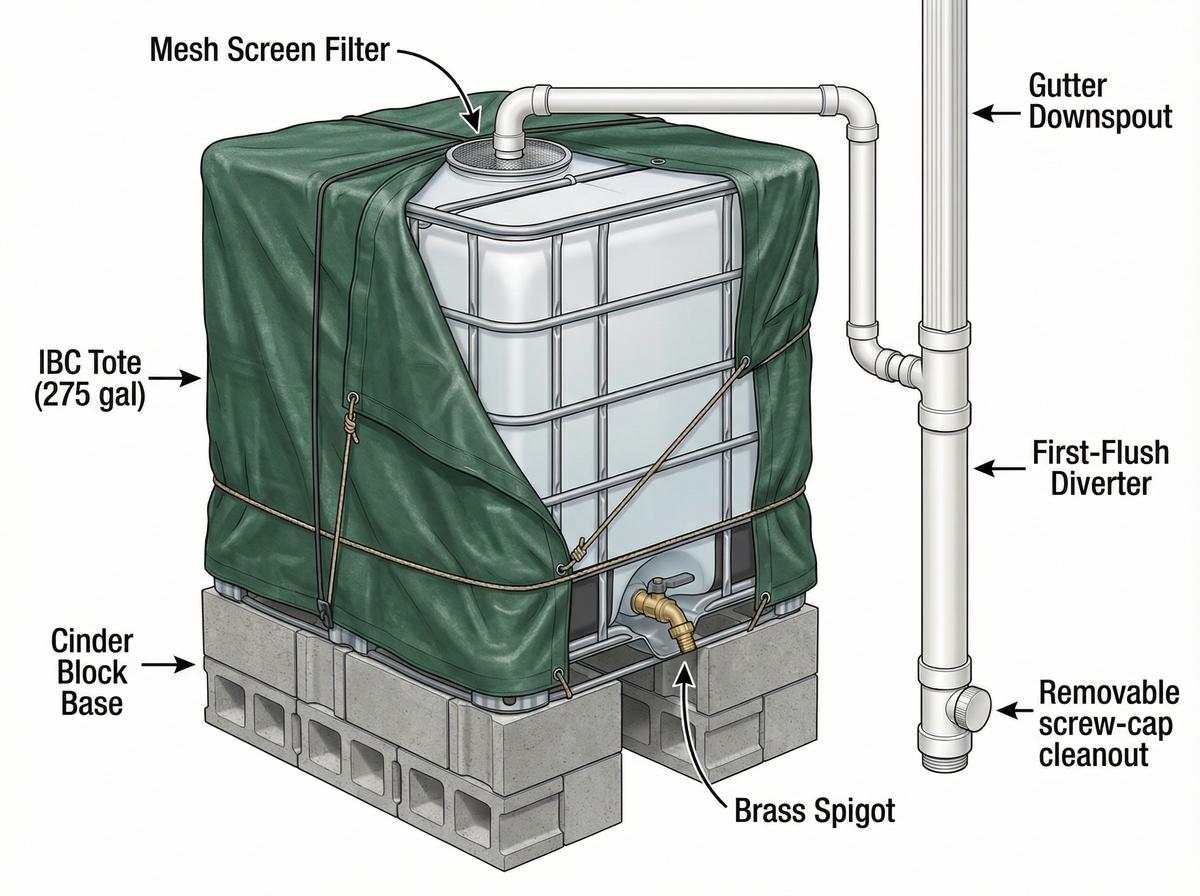
The easiest and most cost-effective way to build a modern cistern is using a 275-gallon IBC (Intermediate Bulk Container) tote.
These are food-grade plastic tanks surrounded by a metal cage. They are cheap, durable, and hold a massive amount of water.
Materials Needed
- One 275-gallon food-grade IBC tote (ensure it previously held food, not chemicals)
- Cinder blocks or pressure-treated lumber (for the base)
- A gutter downspout diverter kit
- PVC pipe and fittings (to route water from the diverter to the tote)
- A fine mesh screen (to keep debris and mosquitoes out)
- A standard brass spigot (to replace the factory valve)
- A dark tarp or heavy-duty paint (to block sunlight and prevent algae)
Step 1: Prepare the Base
Water is incredibly heavy. A full 275-gallon tote weighs over 2,200 pounds.
You must build a solid, level foundation using cinder blocks or pressure-treated lumber.
Elevating the tank provides gravity pressure, making it easier to extract the water later.
Step 2: Position the Tank
Place the IBC tote on the foundation, positioning it near a gutter downspout.
Ensure the factory valve is facing outward and is easily accessible.
Step 3: Install the Downspout Diverter
Cut your existing gutter downspout and install the diverter kit.
This device routes rainwater from the gutter into your PVC pipe system.
Crucially, it also acts as an overflow — when the tank is full, water simply bypasses the diverter and flows down the regular downspout.
Step 4: Route the PVC and Screen
Run PVC pipe from the diverter to the top opening of the IBC tote.
Before the water enters the tank, it must pass through a fine mesh screen to keep leaves, roof grit, and mosquitoes out of your water supply.
Step 5: Block the Sunlight
Algae needs sunlight to grow.
If you leave a clear plastic tote exposed to the sun, it will turn into a green swamp within weeks.
Wrap the tank tightly in a dark, heavy-duty tarp, or paint the exterior with a dark, opaque paint.
Step 6: Upgrade the Valve
Remove the factory valve and install a standard brass spigot using a threaded adapter.
This allows you to easily attach a standard garden hose and connect it directly to your 4 Foot Farm Blueprint garden irrigation system.
Longer-Term Strategies for Total Water Independence
Building a single IBC tote catchment is your first step toward water security.
But true self-reliance requires redundancy.
1. The First-Flush Diverter
The first few minutes of a rainstorm wash all the accumulated dirt, bird droppings, and pollutants off your roof.
You do not want this water in your clean tank.
A first-flush diverter is a simple PVC standpipe installed before the main tank. It captures the initial, dirty runoff. Once the standpipe is full, a floating ball seals it off, allowing the clean, subsequent rain to flow into your main cistern.
This dramatically improves the quality of your stored water — a critical consideration if you’re also using it to support the Homesteader Depot approach to full-property food production.
2. Multi-Tank Linking
One 275-gallon tank is a great start, but it won’t last forever in a severe drought.
You can easily link multiple IBC totes together using PVC pipe connected at their base valves.
As the first tank fills, the water level equalizes across all connected tanks.
This allows you to scale your storage capacity to 500, 1,000, or even 2,000 gallons — the kind of redundancy that Survival Stronghold recommends for any serious preparedness property.
3. Advanced Filtration and Purification
Rainwater harvested from a roof is excellent for watering a garden or flushing toilets.
But before you drink it, it must be purified.
Do not rely solely on boiling.
Invest in a high-quality gravity water filter to remove biological contaminants. For long-term storage, treat the water in your tanks with a small amount of unscented household bleach (about 1/8 teaspoon per gallon) to prevent bacterial growth.
For the health implications of water quality and contamination, the team at Freedom Health Daily covers the latest research — and Freedom Health Alerts will notify you when new threats emerge.
The Portfolio of Resilience
Water is the foundation of survival. But it is only one piece of the puzzle.
To truly insulate yourself from the coming resource collapse, you must build resilience across every aspect of your life.
Master Your Health: When the medical supply chain breaks down, you must be your own doctor. Learn the critical alternative therapies at Seven Holistics.
Optimize Your Nutrition: You cannot survive a crisis on a weak foundation. Build your physical resilience with the protocols at Seven Nutrition.
Get the Premium Intel: For the most advanced, actionable preparedness strategies, you need the deep-dive reports at The Ready Report.
Track the Cycles: History doesn’t repeat, but it rhymes. Understand the historical patterns driving this collapse at The Pattern Ledgers.
And for the daily, actionable skills that will keep you alive when the system fails, keep reading the Self Reliance Report.
The water is drying up.
The system is cracking.
Do not wait for the taps to run dry.
Build your cistern today.