
One year ago, the American economy was promised liberation through sweeping new tariffs on global imports. The promise was simple: protect American jobs and rebuild domestic manufacturing. But the math tells a different story. Today, the U.S. goods trade deficit has hit an all-time high, and the manufacturing sector has shed 100,000 jobs. The reality is that tariffs are not paid by foreign governments; they are paid by domestic consumers and businesses. When the cost of imported agricultural chemicals, steel, and basic goods skyrockets, the American family pays the price. We are watching a centralized system attempt to tax its way to prosperity, squeezing the working class to fund an experiment that is actively failing.
But this is not the first time the American people have faced crushing economic extraction.
The Last Time Washington Tried This
During the Great Depression, the government passed the Smoot-Hawley Tariff Act of 1930. It was designed to protect domestic farmers and industries by raising import duties to record levels. Instead, it triggered a global trade war, collapsed international markets, and deepened the economic misery of the average American family. The people who built things, grew things, and made things were suddenly cut off from affordable supplies and markets.
They didn’t wait for Washington to fix the math. They decentralized their own lives.
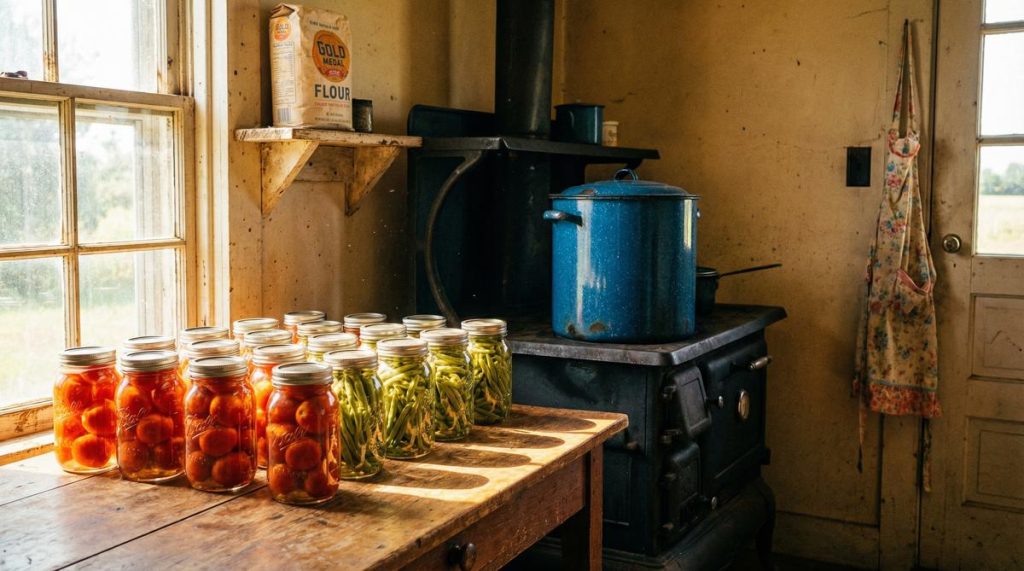
Faced with skyrocketing costs and failing supply chains, the Great Depression generation turned to hyper-local resilience. They built what became known as the “Victory Pantry” — a localized, inflation-proof food system that insulated their families from the shocks of a failing national economy. They didn’t just store food; they preserved it, traded it, and built community networks around it. They understood that when the centralized economy becomes a trap, the only logical response is to build your own supply chain.
You can do the exact same thing today.
The One Skill That Changes Everything
The most powerful weapon against economic extraction is the ability to preserve your own harvest.
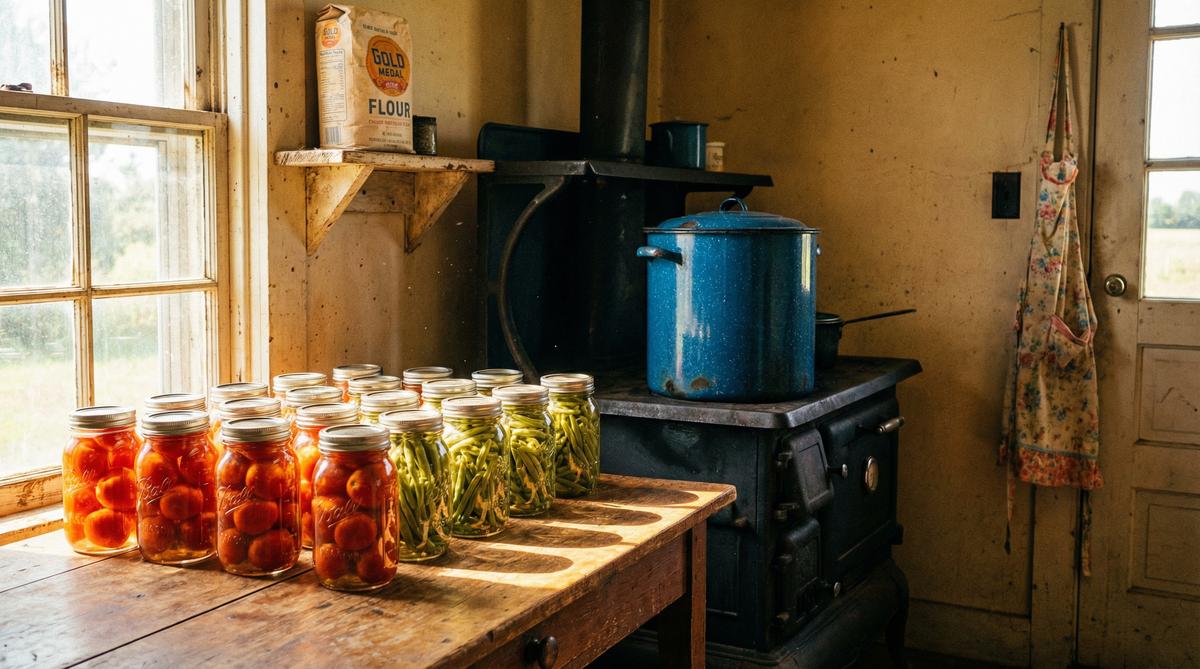
Water bath canning is the foundational skill of the Victory Pantry. It requires minimal equipment, no electricity once the jars are sealed, and allows you to lock in the nutritional value of high-acid foods for years. When the cost of groceries doubles because of supply chain shocks, a well-stocked pantry of home-canned goods is better than money in the bank. It is tangible, edible wealth that no tariff can touch.
Here is exactly how to start building your own Victory Pantry this weekend.
What You Need
- A large boiling water canner (or any large, deep pot with a lid and a rack)
- Glass Mason jars (quart or pint size)
- New two-piece canning lids and bands
- A jar lifter
- A wide-mouth funnel
- A non-metallic spatula or bubble remover
Step-by-Step: Your First Batch of Canned Tomatoes
Step 1: Gather Your Equipment. You do not need a massive industrial setup. A large enamel canner or any deep pot with a lid and a rack on the bottom will work. Glass Mason jars, new two-piece lids, a jar lifter, and a wide-mouth funnel are your complete toolkit.
Step 2: Select High-Acid Foods. Water bath canning is strictly for high-acid foods. This includes tomatoes, fruits, jams, jellies, and pickled vegetables. Do not attempt to water bath can low-acid foods like meats or unpickled vegetables — those require a pressure canner.
Step 3: Prepare the Jars and Food. Wash your jars, lids, and bands in hot, soapy water. Keep the jars hot until you are ready to fill them. Prepare your recipe — whether it is crushed tomatoes or pickled cucumbers — according to a tested, safe canning recipe.
Step 4: Fill and Remove Air Bubbles. Use your wide-mouth funnel to carefully ladle the hot food into the hot jars. Leave the appropriate headspace — the empty space between the food and the rim of the jar — usually about half an inch for tomatoes. Run a non-metallic spatula around the inside of the jar to release any trapped air bubbles.
Step 5: Wipe, Cap, and Process. Wipe the rim of the jar with a clean, damp cloth to ensure a perfect seal. Place the lid on top and screw the band on until it is “fingertip tight.” Use your jar lifter to lower the jars into the boiling water canner. Ensure the water covers the jars by at least one to two inches. Place the lid on the canner and process for the time specified in your recipe.
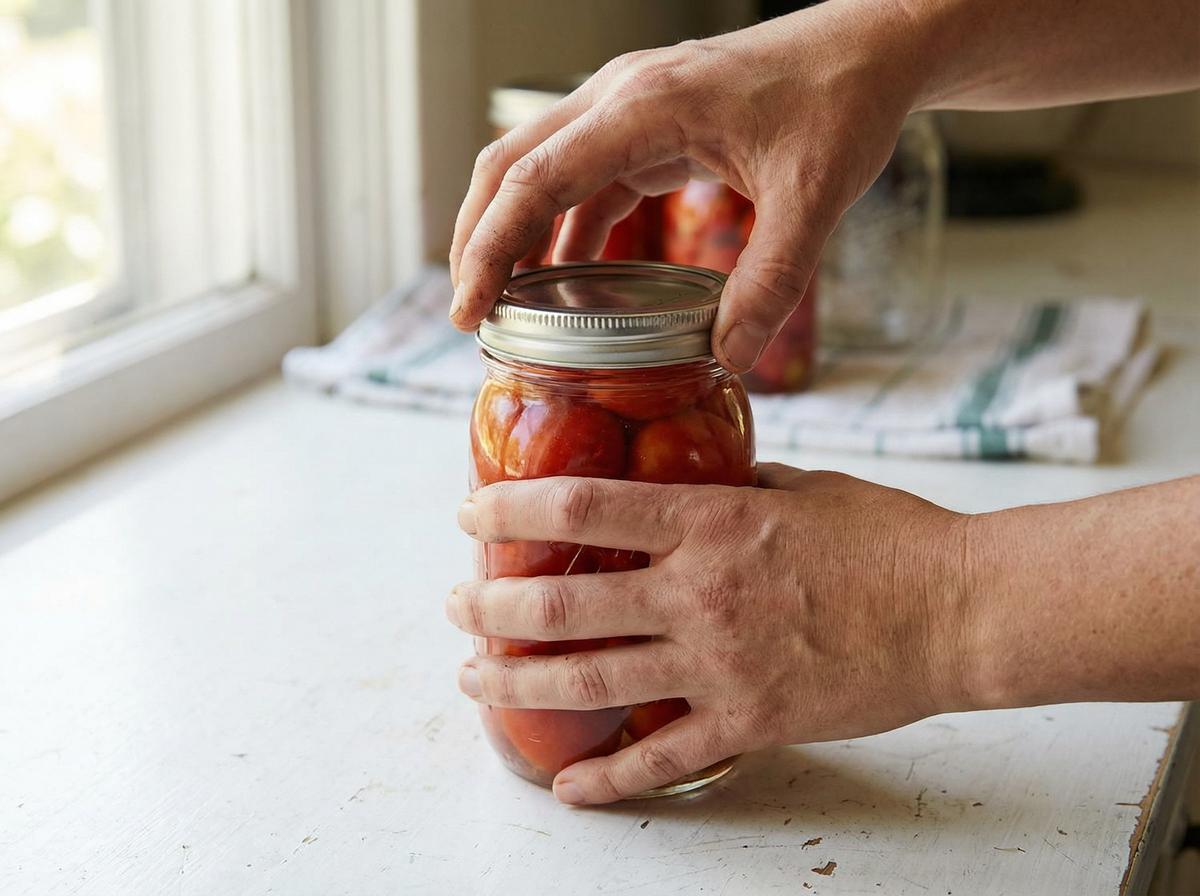
Step 6: Cool and Store. Carefully remove the jars and place them on a towel on your counter. Do not touch them for 12 to 24 hours. You will hear the satisfying “ping” as the lids seal. Once cooled, remove the bands, check the seals, label the jars with the date, and store them in a cool, dark place.
You have just minted your own currency.
The Economics of the Pantry
Why does a pantry matter when the global economy is shifting? Because food is the ultimate currency. When supply chains break down, the cost of basic necessities skyrockets. We saw this during the pandemic, and we are seeing it again now with the new tariff regime. The cost of fertilizer, seeds, and transportation are all increasing. Those costs are passed directly to the consumer at the grocery store.
By preserving your own food, you are effectively locking in today’s prices for tomorrow’s meals. You are bypassing the middleman, the transportation costs, and the retail markups. You are creating a closed-loop economic system within your own home.
This is the exact strategy used by our grandparents during the Great Depression. They didn’t have the luxury of relying on a fragile, just-in-time supply chain. They knew that true security came from what they could produce and preserve themselves.
The Community Network
A well-stocked Victory Pantry also serves as the foundation for a hyper-local barter economy. When cash loses its value or becomes scarce, tangible goods become the medium of exchange. A dozen jars of home-canned tomatoes or pickled vegetables can be traded for eggs, milk, or labor.
This is how communities survive economic collapse. They stop relying on the centralized system and start relying on each other. By building your own pantry, you are not just protecting your family; you are creating a valuable asset that can be used to support and strengthen your local network.
Longer-Term Strategies: Building Your Full Resilience Stack
Water bath canning is just the beginning. As you build your skills, you can expand into pressure canning, dehydration, and root cellaring. Each new skill adds another layer of resilience to your household.
Once you master preservation, the next logical step is to control the source of the food itself. The 4 Foot Farm Blueprint teaches you how to create a high-yield, sustainable food source in a fraction of the space, ensuring you always have fresh produce to preserve — even on a small urban lot.
If you want to protect your wealth from the silent theft of inflation and understand the economic patterns playing out right now, The Pattern Ledgers delivers the financial analysis the mainstream media won’t publish.
If you want to build a homestead that can weather any economic storm — from tariff shocks to supply chain collapses — the Homesteader Depot provides the tools and knowledge you need to get started today.
And if you want to ensure your family’s health and preparedness when the systems fracture, Seven Holistics, Freedom Health Daily, and Freedom Health Alerts offer the critical insights you won’t find anywhere else.
For premium intelligence on what’s coming next — and how to position your family ahead of it — The Ready Report and Survival Stronghold are where serious builders go for serious analysis.
To understand the broader political and societal context of these economic shifts, read the latest analysis at American Downfall.
And for more actionable strategies on building a resilient, independent life, continue reading the Self Reliance Report.
The empire may be taxing itself to death. But you don’t have to go down with it.
Start building today.