
In the 15th century, the mighty Kongo Kingdom, a once-thriving African empire, traded its sovereignty for beads, unwittingly sowing the seeds of its own collapse.
This historical misstep serves as a stark reminder that currency collapse and foreign dependency are not mere relics of the past; they are ominous warnings for our future.
America’s dollar, showing undeniable signs of instability, echoes the Kongo’s fatal mistake.
Self-reliance is not just wise—it’s essential in today’s volatile economic landscape.
In a world where the value of currency can vanish overnight, ensuring your own survival and prosperity becomes not just critical, but an imperative.
Understanding history isn’t just about knowledge—it’s about preparing for the future.
Act now to secure your independence before it’s too late.
When Paper Money Became Wallpaper: The Weimar Lesson
Consider the Weimar Republic’s hyperinflation of 1923, a stark reminder that when paper money becomes worthless, tangible assets reign supreme.
The middle class, once comfortable and stable, saw their life savings evaporate as Germany’s currency spiraled out of control.
In a matter of months, people were wheelbarrowing stacks of banknotes to buy a single loaf of bread.
Yet, amidst this chaos, some families protected their wealth by thinking outside the bank.
They built self-reliance through home production, ensuring their survival and stability amidst the economic turmoil.
Take the Bauer family, who transformed their backyard into a miniature farm, cultivating potatoes and vegetables to sustain themselves when store shelves were bare.
They understood that food was a currency, and it was a currency they could produce themselves.
Families like the Müllers invested in tangible assets such as gold and silver, which retained value even when the mark crumbled, demonstrating that precious metals hold their allure in both tough times and prosperity.
Meanwhile, the Kraus family created a “tangible currency” pantry, stocking it with non-perishable essentials like coffee, sugar, and salt.
These items became trading commodities, far more valuable than the paper promissory notes the government churned out by the billions.
In households where tools were cherished, the ability to repair, build, and barter gave them an edge.
Hammer and nails became more than just tools; they were instruments of negotiation.
These families knew that survival wasn’t about having money; it was about having what money couldn’t buy when the system failed.
History taught them that self-reliance is the ultimate insurance policy.
They understood that a pantry brimming with essentials was a bank of its own kind, one that inflation couldn’t touch.
In the midst of devastation, the resourceful thrived while the unprepared suffered.
These families didn’t just survive; they emerged stronger, thanks to their foresight and commitment to self-reliance.
The lesson is clear: when currency collapses, those who are prepared and resourceful don’t just endure—they thrive.
People just like you faced this before—and they found a way through.
What will you do when the value of money fades?
The Teachable Strategy: Build Your Tangible Currency Pantry
When paper money crumbles, tangible currency prevails.
In a currency collapse, your dollar bills could become as worthless as Monopoly money overnight.
But there’s a strategy that has stood the test of time: establishing a “Tangible Currency” Pantry.
Forget hoarding paper money; the real value lies in stockpiling high-value, long-lasting trade goods and essential calories.
Think of items like dried beans, rice, honey, and salt—not just as food, but as currency that never devalues.
Why? Because these items have intrinsic value that meets fundamental human needs.
In times of economic turmoil, people will trade almost anything for food and essentials.
Your pantry becomes a bank, where a pound of rice or a jar of honey is worth more than a stack of crumbling currency.
Start this week: dedicate a corner of your home to your Tangible Currency Pantry.
Invest in bulk purchases of non-perishable goods—stuff like canned meats, dried legumes, and grains.
A ten-pound bag of rice is more than just survival food; it’s a barter item that can secure you goods or services.
Unlike “survival food,” which is often freeze-dried or packaged for emergencies, tangible currency food is everyday fare with a long shelf life.
Survival food is for your immediate need; tangible currency food is for trade and long-term sustenance.
It’s like having a vault of gold, but much more practical when the chips are down.
And don’t underestimate the value of spices and coffee—these are luxury items that become highly desirable in scarcity.
Step-by-Step: How to Build Your Tangible Currency Pantry
Materials List:
- Mason jars with airtight lids
- Mylar bags
- Oxygen absorbers
- Heat sealer or household iron
- Salt
- Sugar
- Grains (rice, wheat, etc.)
- Shelving unit
- Labels and permanent marker
Step 1: Sourcing Your Tangible Currency
- Identify and purchase high-demand, non-perishable items such as salt, sugar, and grains. These are your tangible currencies in times of crisis.
- Choose reputable suppliers to ensure the quality and longevity of your goods.
- Opt for bulk purchases to save money and maximize your pantry stockpile.
Step 2: Preparing Your Storage Containers
- Wash and dry mason jars thoroughly to prevent contamination.
- Check Mylar bags for any defects and ensure they are clean and dry before use.
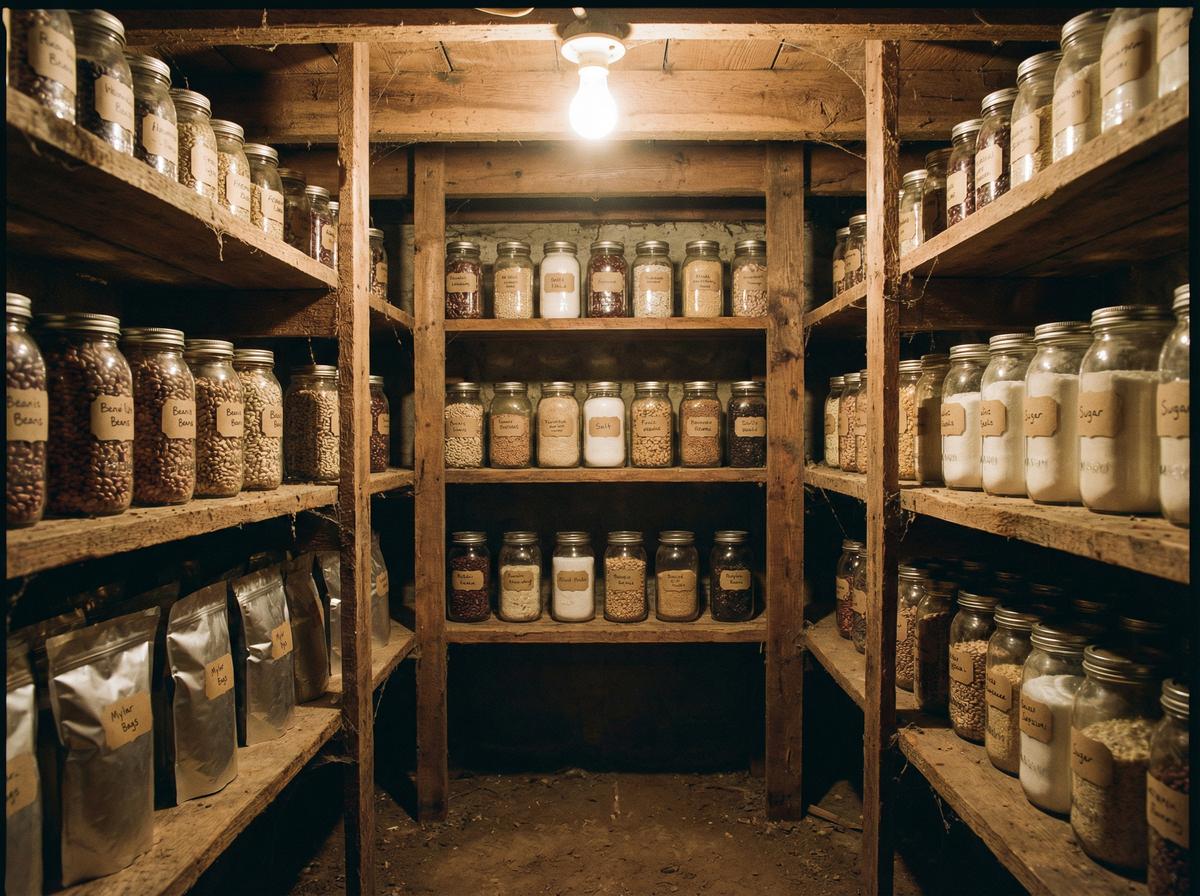
- Organize a dedicated shelving unit in a cool, dark area like a basement or root cellar.
Step 3: Packaging Your Currency
- Fill mason jars with salt and sugar, leaving about an inch of space from the top.
- Add oxygen absorbers to each jar before sealing to extend shelf life.
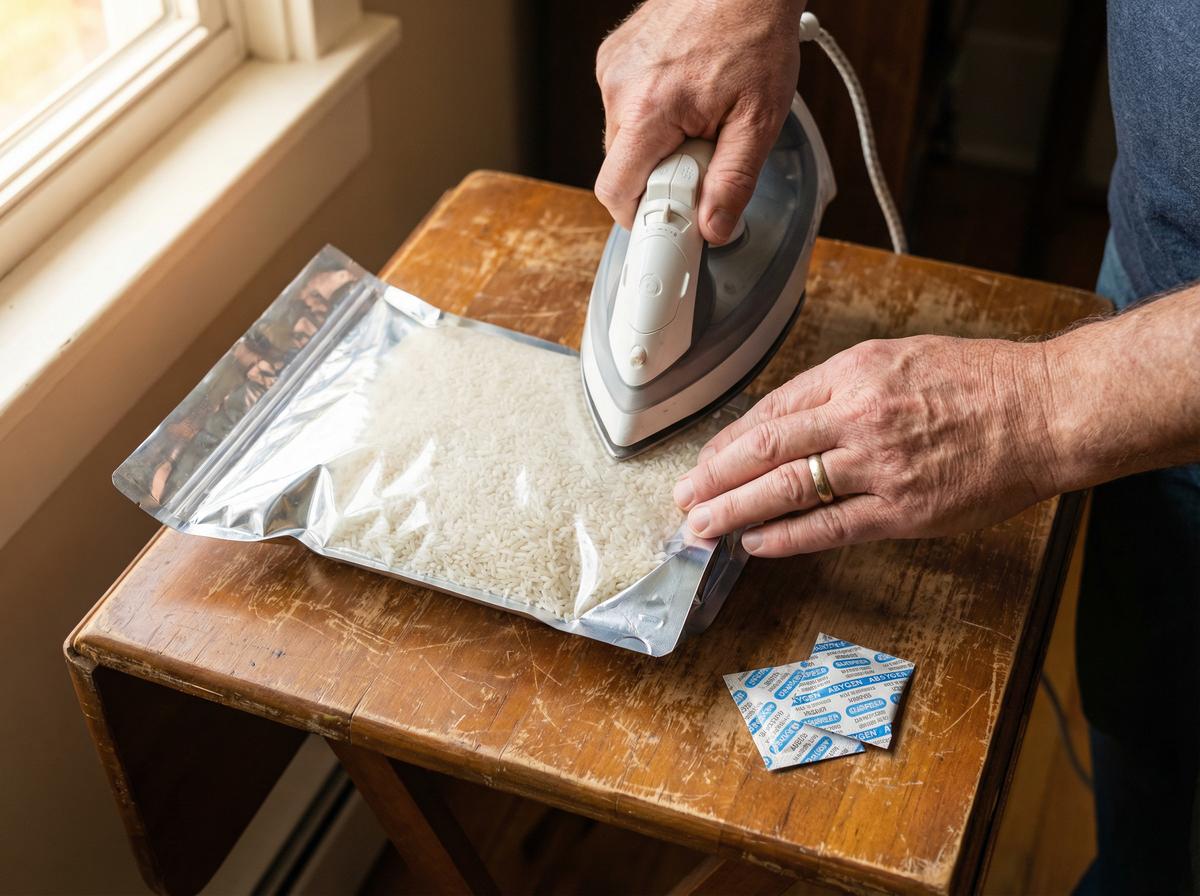
- For grains, use Mylar bags; pour them in, leaving enough room to seal.
- Insert an oxygen absorber into each Mylar bag and quickly move to the sealing process.
Step 4: Sealing for Longevity
- Use a heat sealer or iron to seal Mylar bags, ensuring an airtight closure. It’s crucial for long-term preservation.
- Double-check each seal by gently pressing the bags to ensure no air leaks.
- Screw lids tightly onto mason jars, verifying they are secure and airtight.
Step 5: Storing Your Tangible Currency
- Arrange jars and bags neatly on your shelving unit for easy access and inventory management.
- Label each container with the contents and date of packaging for quick identification.
- Store in a dimly lit, temperature-stable environment to prevent degradation of your stockpile.
Step 6: Regular Maintenance
- Conduct monthly checks to ensure seals remain intact and there are no signs of spoilage.
- Rotate your stock by using older items first and replenishing with fresh supplies.
- Keep an updated inventory list to track your tangible currency’s status and plan future purchases.
By following these steps, you secure a reliable reserve of valuable barter items, ensuring your independence and preparedness for any economic situation.
Longer-Term Strategies: From Stockpiling to Sovereignty
In the face of a currency collapse, your survival depends on more than just a well-stocked pantry.
It’s time to transition from merely stockpiling to cultivating sustainability with longer-term strategies that will see you through the storm.
Strategy One: Embrace Seed Saving and Homegrown Produce.
Imagine stepping into your backyard and harvesting fresh vegetables, knowing you are untouchable by market fluctuations.
Start with the 4 Foot Farm Blueprint, which provides insights into maximizing small spaces for bountiful yields.
Once you have your seeds, Seven Holistics offers tips on holistic gardening practices that boost plant health and productivity.
By mastering seed saving, you’ll ensure a continuous food supply, immune to economic chaos.
Strategy Two: Raise Livestock for Sustained Protein.
Transition from canned meats to raising chickens, rabbits, or goats, which can provide eggs, milk, and meat.
Turn to Survival Stronghold for expert advice on animal husbandry that doesn’t break the bank.
For comprehensive guides and supplies, Homesteader Depot has everything you need to start your mini-farm.
This move not only secures your protein source but gives you valuable bartering power when currency fails.
Strategy Three: Build a Community Barter Network.
In challenging times, a strong community can be your most invaluable resource.
Connect with like-minded individuals through The Pattern Ledgers, where you can discover patterns of successful barter networks throughout history.
American Downfall discusses the socio-economic impacts of collapse and the importance of community resilience.
By establishing a network, you’ll have access to a wider array of goods and services, ensuring you never face a shortage alone.
These strategies aren’t just about survival—they’re about thriving in the face of adversity.
Stay informed with Freedom Health Daily and Freedom Health Alerts for health tips that complement your self-reliance journey.
Keep your finger on the pulse with the Ready Report and Self Reliance Report for the latest strategies and survival news.
Act now—your future self will thank you.